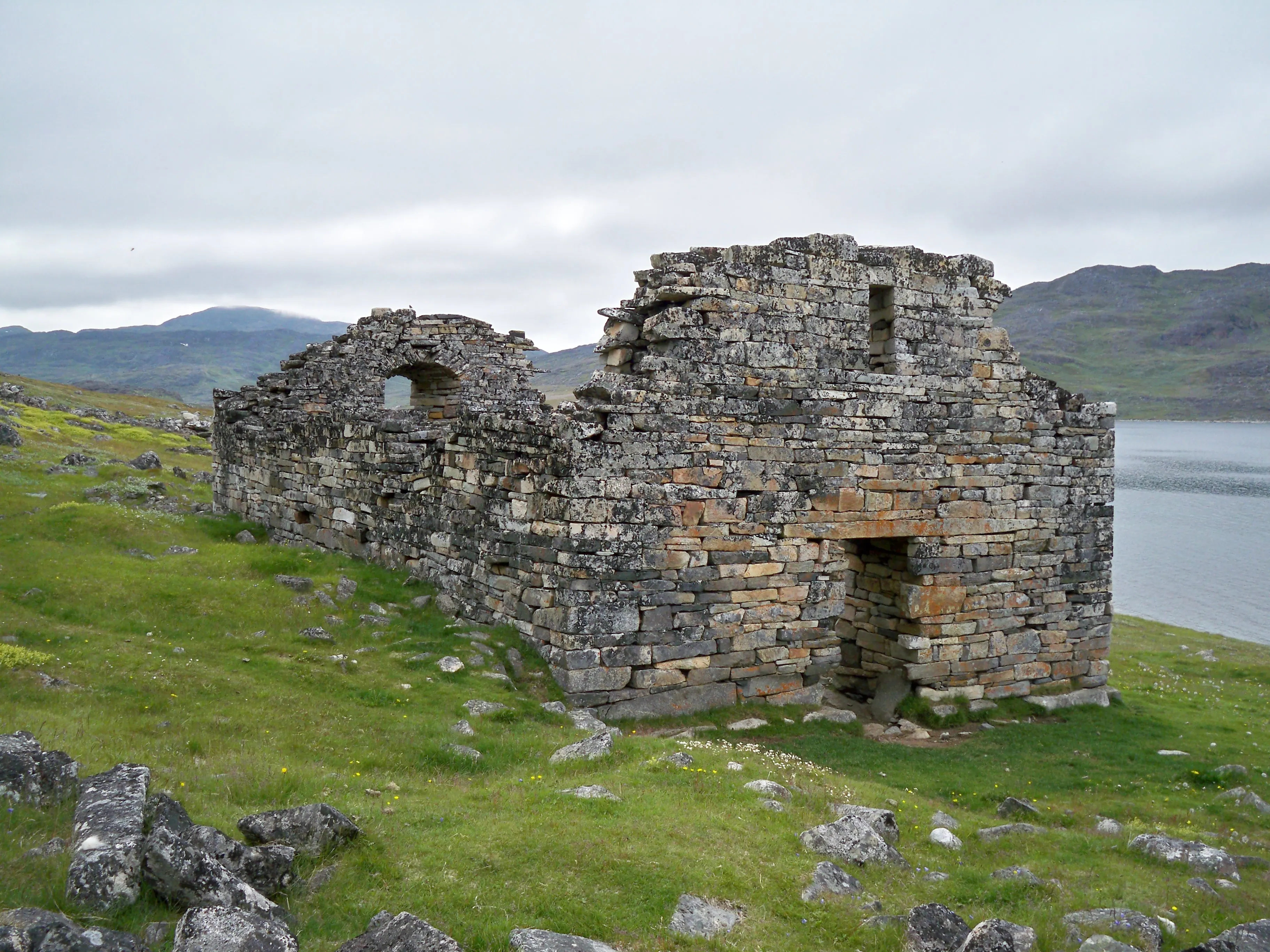
The ruined stone walls of Hvalsey Church in Greenland, site of the last documented event in Norse Greenland's written record.
WIKIMEDIA COMMONS CONTRIBUTOR

Greenland Norse Settlements

Norse Greenland · Eastern Settlement · Western Settlement
ARCHAEOLOGICAL

Mainstream consensus: Well-excavated medieval farming settlements with a documented multi-causal decline across generations.

Share this page
Short answer

Norse farmers settled Greenland's fjords around 985 CE under Erik the Red and held on for roughly 450 years before the Eastern and Western Settlements fell silent. Climate cooling, a collapsed ivory market, and strained Inuit relations explain the end - not a single vanishing night, and no lost high-tech colony swallowed by ice.

Mainstream view

Norse Greenlanders farmed, raised livestock, and traded walrus ivory for roughly four centuries. Cooling climate, soil exhaustion, a crashed ivory trade after African tusks reached Europe, and friction with expanding Thule Inuit populations combined to end the settlements - documented decline, not sudden mystery.

Alternative claim

Popular retellings compress the ending into one dramatic die-off, overstate plague or massacre, or suggest the colonists "disappeared" without explanation.

Greenland's Norse chapter opens with Erik the Red steering settlers past the pack ice in 985 CE and naming the place for its greener fringes. Farmsteads, churches, and a cathedral at Gardar followed, built from turf and imported timber across two clustered settlements hugging the southwest fjords. For roughly four centuries this was a working edge of the Norse Atlantic world, trading walrus ivory and seal products back toward Norway.

The end did not arrive as one dramatic night. Tree-ring records and ice cores show the climate cooling through the 1300s, shortening growing seasons for barley and hay that livestock depended on. At the same time, the European ivory market that had kept Greenland solvent took a hit as African elephant tusks reached merchants through new trans-Saharan and Portuguese trade routes - Greenlandic walrus tusk simply stopped paying the bills.

Relations with the Thule Inuit, who were themselves expanding south along the coast, add another documented pressure, though archaeology resists the older "massacre" narrative. Isotope studies of Norse bones show a diet shifting more toward marine resources in later generations - people adapting to a harsher landscape rather than disappearing in an instant.

The paper trail runs out with a wedding. A 1408 marriage recorded at Hvalsey Church is the last firmly dated event from the colony, and the church's stone walls - rare survivors of Greenland's weather - still stand near Qaqortoq. By the mid-15th century, farm layers across both settlements show abandonment, not catastrophe.

Peers in the same climate-and-contact story include Vinland, the Norse foothold farther west, and Ancestral Puebloans, whose own 13th-century migrations track a parallel medieval climate squeeze on a different continent. The licensed photo of Hvalsey belongs here because that ruin is the closing scene archaeology can actually document.

Popular retellings keep reaching for plague, war, or a hidden surviving colony because a slow multi-cause ending is a less tidy story than a single vanishing. The record specialists work with - middens, isotopes, farm boundaries, church stones - argues for people making hard choices across generations until the choices ran out.

Documentary photos

Rights-cleared documentary stills and serious reference images. These are not AI illustrations.

Hvalsey Church, Eastern SettlementCredit: Wikimedia Commons contributor

Key debates and stories

Attributed discovery narratives, debates, and claim histories from named sources. Links open the originals; AnomalyWiki does not verify these claims.

Claims vs mainstream

The claim

The Greenland Norse vanished overnight in one unexplained event.

Mainstream view

Tree rings, isotopes, and farm abandonment layers show a gradual retreat over decades, not a single catastrophe.

The claim

Plague or a massacre wiped out the colonies.

Mainstream view

No mass-grave or epidemic evidence supports plague; conflict with Inuit groups is documented but not as a single extermination event.

The claim

The colonists secretly relocated and a hidden Norse enclave survived in North America.

Mainstream view

No archaeological trace of a continuing Greenlandic Norse colony has been found anywhere else; the last confirmed written record is a 1408 wedding at Hvalsey.

The claim

Climate alone explains the end.

Mainstream view

Specialists weigh cooling alongside economic collapse (ivory prices) and social/trade ties to Norway and Inuit neighbors - a combined pressure story.

Timeline

  1. 985 CEErik the Red leads settlers from Iceland to found the Eastern and Western Settlements.Source: Icelandic saga tradition; Norse Greenland archaeology
  2. c. 1126A bishopric is established at Gardar, tying Greenland into the Norwegian church and trade network.Source: Medieval ecclesiastical records
  3. c. 1300sLittle Ice Age cooling intensifies; ice core and farm-layer data show shortening growing seasons.Source: Greenland ice core and paleoclimate studies
  4. 1408The last documented event in Norse Greenland - a wedding recorded at Hvalsey Church.Source: Icelandic annals
  5. c. 1450Archaeological evidence (abandoned farms, cooling midden layers) indicates both settlements are depopulated.Source: Norse Greenland settlement chronologies

FAQ

Who settled Norse Greenland?

Icelandic settlers led by Erik the Red established the Eastern and Western Settlements starting around 985 CE.

Did the Greenland Norse vanish suddenly?

No. Farm abandonment and climate data show a gradual retreat over generations, not an overnight disappearance.

Why did the settlements fail?

Cooling climate, a collapsed walrus-ivory export market, soil exhaustion, and strained relations with Thule Inuit neighbors combined over time.

What is the last known record from the colony?

A 1408 wedding recorded at Hvalsey Church, whose stone walls still stand in southern Greenland.

Did any Norse Greenlanders survive by fleeing elsewhere?

No confirmed archaeological trace of a surviving colony has been found; the settlements simply went quiet in the historical and excavation record.

Can you visit the sites today?

Hvalsey Church and other Eastern Settlement ruins are accessible near Qaqortoq, Greenland, and are protected as heritage sites.