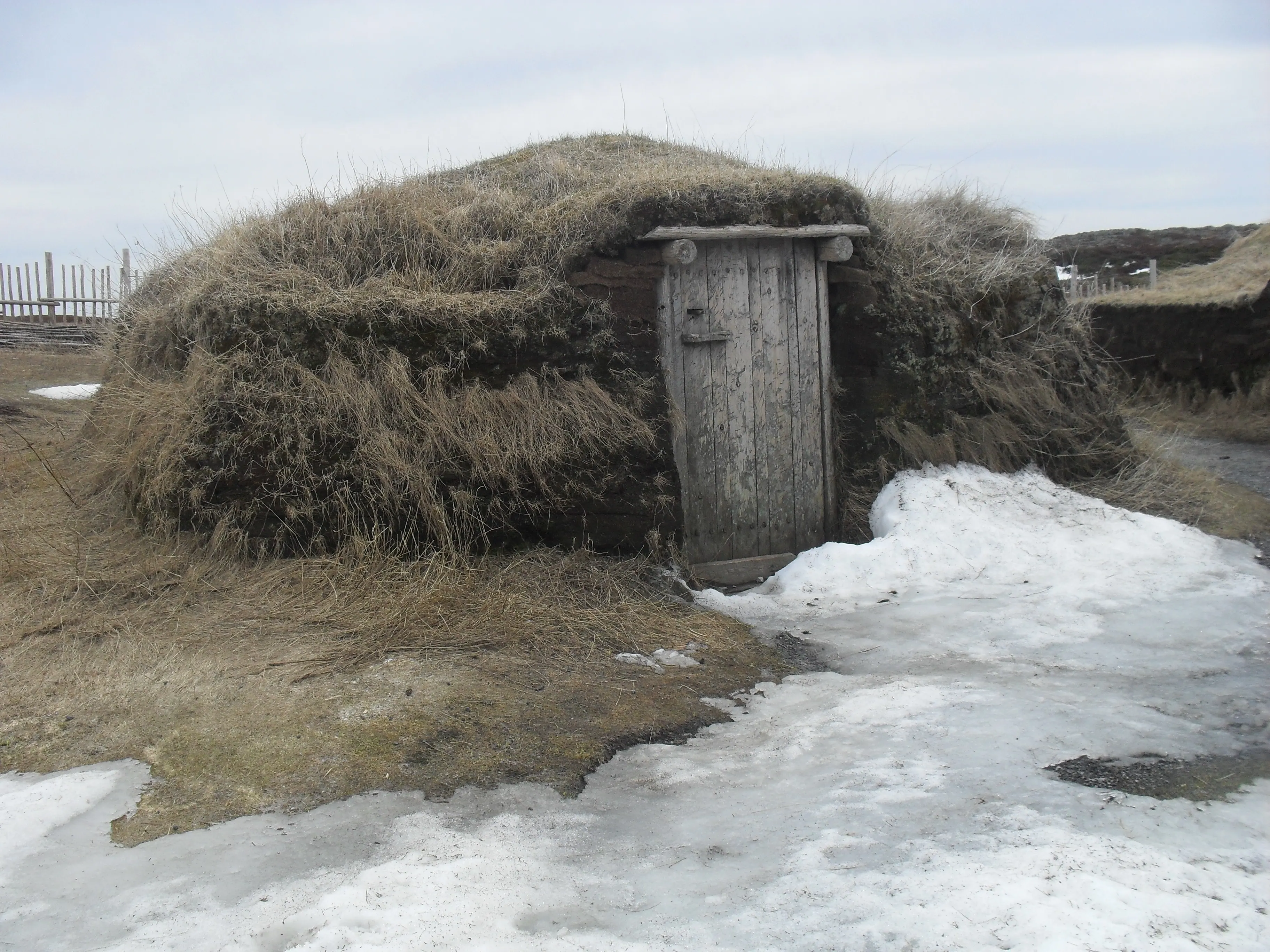
Reconstructed Norse turf longhouses at L'Anse aux Meadows National Historic Site, Newfoundland, Canada.
WIKIMEDIA COMMONS CONTRIBUTOR

Vinland

Vinland the Good · L'Anse aux Meadows
ARCHAEOLOGICAL

Mainstream consensus: Confirmed, precisely dated Norse presence at one excavated site; broader "Vinland" extent beyond that site remains geographically debated among specialists, not fringe-versus-mainstream.

Share this page
Short answer

Vinland is the Norse name for lands the Greenland colony reached around 1000 CE, confirmed by the excavated encampment at L'Anse aux Meadows, Newfoundland. Tree-ring analysis tied to a 993 CE solar storm dated Norse wood-cutting there precisely to 1021 CE - predating Columbus by nearly five centuries, though Vinland itself was never permanently colonized.

Mainstream view

Norse Greenlanders made exploratory and resource-gathering voyages to parts of Atlantic Canada around 1000 CE, establishing a small seasonal base camp at L'Anse aux Meadows, but did not found a lasting colony there - likely due to distance from Greenland and friction with Indigenous peoples.

Alternative claim

Some fringe writers claim extensive, long-term Norse colonization deep into North America, citing contested artifacts like the Kensington Runestone or the Maine penny as proof.

Vinland starts as a saga name and ends as one of archaeology's cleanest precision victories. Icelandic sagas describe Norse Greenlanders, including Leif Erikson, sailing west around 1000 CE and naming a timbered coast for the grapes or berries they found there. For centuries that was literature, not proof - until a Norwegian couple went looking for the ground it described.

Helge and Anne Stine Ingstad excavated turf-walled buildings and Norse-style iron-working debris at L'Anse aux Meadows, Newfoundland, starting in 1960, confirming the first verified Norse site anywhere in the Americas. UNESCO listed it as a World Heritage Site in 1978, and the sod-roofed longhouses visitors see today are careful reconstructions standing on the excavated footprint.

Dating got dramatically sharper in 2021. Researchers matched a rare radiocarbon spike - a fingerprint left in tree rings worldwide by a solar storm in 993 CE - against wood the Norse had cut and felled at the site. Counting growth rings outward from that spike pinned the felling date to exactly 1021 CE, making it the most precisely dated moment of pre-Columbian European presence anywhere in the Americas, nearly five centuries ahead of Columbus.

What the site does not support is a lasting colony. The scale and short occupation window point to a seasonal base for exploration, timber-gathering, and ship repair - consistent with sagas describing voyages rather than settlement. That modest, well-evidenced picture is exactly what fringe writers skip past when they lean on the Kensington Runestone or the Maine penny to argue for deep Norse penetration into the continental United States; mainstream archaeology treats the runestone as a probable forgery and the penny as an isolated find, neither strong enough to move the confirmed Norse footprint south of Newfoundland.

Peers in the same "documented Norse reach, debated extent" category include the Greenland settlements that launched these voyages, and thematically, abandoned-colony mysteries like Roanoke make a useful contrast - a disappearance genuinely short on physical evidence, unlike Vinland's excavated, tree-ring-dated certainty.

Documentary photos

Rights-cleared documentary stills and serious reference images. These are not AI illustrations.

L'Anse aux Meadows, NewfoundlandCredit: Wikimedia Commons contributor

Key debates and stories

Attributed discovery narratives, debates, and claim histories from named sources. Links open the originals; AnomalyWiki does not verify these claims.

Claims vs mainstream

The claim

Vinland proves extensive, long-term Norse colonization of North America.

Mainstream view

The only confirmed Norse site, L'Anse aux Meadows, shows short-term seasonal occupation (an estimated handful of years) by a small group - a waystation, not a lasting colony.

The claim

The Kensington Runestone and Maine penny prove Norse presence deep in the continental US.

Mainstream view

Mainstream archaeology treats the Kensington Runestone as a near-certain 19th-century forgery and the Maine penny as an isolated, unprovenanced find that does not establish Norse settlement.

The claim

Vinland's exact location is unknown or unknowable.

Mainstream view

L'Anse aux Meadows is a firmly excavated and dated Norse site; debate continues over whether saga "Vinland" describes a wider region including it or areas further south.

The claim

Norse voyages to Vinland are saga fiction with no archaeological basis.

Mainstream view

Radiocarbon dating, Norse-style structures, iron-working debris, and a precisely dated tree-ring event at L'Anse aux Meadows confirm genuine Norse presence matching the saga window.

Timeline

  1. c. 1000 CESagas describe Leif Erikson and other Norse explorers from Greenland reaching Vinland.Source: Saga of Erik the Red; Greenlanders' Saga
  2. 1960Helge and Anne Stine Ingstad begin excavating a Norse site at L'Anse aux Meadows, Newfoundland.Source: Ingstad excavation reports
  3. 1978UNESCO inscribes L'Anse aux Meadows as a World Heritage Site.Source: UNESCO World Heritage Centre listing
  4. 2021Tree-ring analysis tied to a dated 993 CE solar storm precisely dates Norse wood-cutting at the site to 1021 CE.Source: Nature (Kuitems et al., 2021)

FAQ

What is Vinland?

The Norse name for lands reached from Greenland around 1000 CE, confirmed archaeologically at L'Anse aux Meadows in Newfoundland.

How precisely is the Norse presence dated?

A 2021 tree-ring study matched a 993 CE solar storm signature in cut wood at the site, dating Norse activity there to exactly 1021 CE.

Who excavated L'Anse aux Meadows?

Norwegian explorers Helge and Anne Stine Ingstad led excavations starting in 1960 that confirmed the first verified Norse site in North America.

Was Vinland a permanent Norse colony?

No - evidence points to a small, short-term seasonal base used for exploration and resource gathering, not a lasting settlement.

Do the Kensington Runestone and Maine penny prove deeper Norse settlement?

Mainstream archaeology treats the runestone as a likely 19th-century forgery and the penny as an isolated find that cannot establish settlement on its own.

Does this mean Leif Erikson reached America before Columbus?

Yes - the dated Norse presence at L'Anse aux Meadows predates Columbus's 1492 voyage by roughly 470 years.