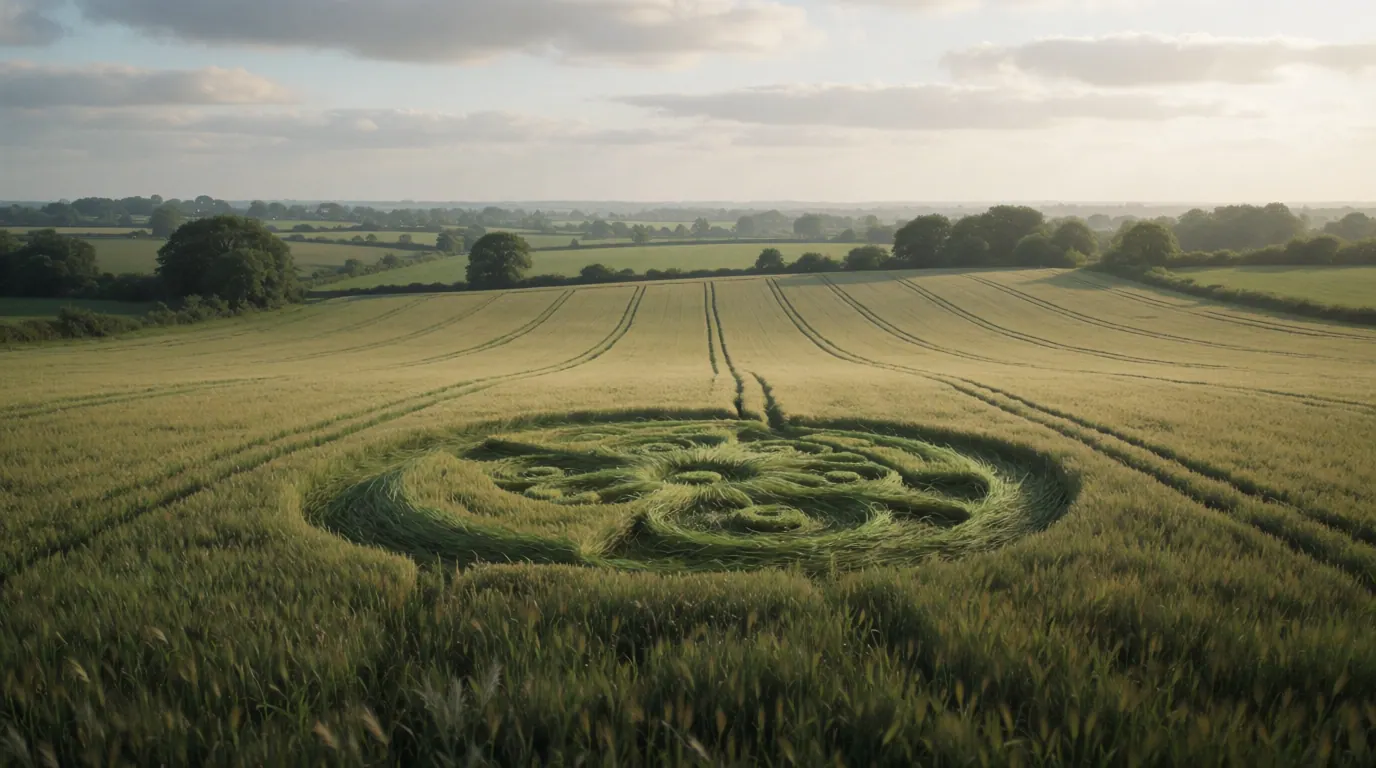
AI illustration cover for Crop Circles
AI ILLUSTRATION FOR REFERENCE ONLY

Crop Circles

Crop circle · Corn circle · Cereology
HOAX

Mainstream consensus: Flattened crop patterns are real physical marks in fields. The 1991 Bower-Chorley confession, decades of paid circlemaker demonstrations, and the exposed Oliver's Castle "proof" video support a human-made explanation for the modern wave. Plant-tissue and plasma-vortex claims for a residual non-human subset have not been independently replicated under controlled conditions.

Share this page
Short answer

Crop circles are flattened patterns in grain fields across England, multiplying from simple rings in the late 1970s into elaborate pictograms by the 1990s. Doug Bower and Dave Chorley confessed in 1991 to making hundreds with planks and rope since 1978. Mainstream science treats the wave as human-made land art; cereologists still argue a handful resist that explanation.

What happened

A 1678 English pamphlet called The Mowing-Devil shows the earliest widely cited circular field pattern - oats cut overnight and blamed on the Devil. Modern reports begin in the late 1970s in Wiltshire and Hampshire, when simple rings started appearing in wheat and barley. By the 1980s the designs grew into pictograms: rings linked by avenues, satellite circles, and spurs that outpaced meteorologist Terence Meaden's whirlwind "plasma vortex" idea.

Everything changed in September 1991. Painters Doug Bower and Dave Chorley told the tabloid Today they had been flattening circles with wooden planks and rope since 1978, inspired by UFO lore and Australia's 1966 Tully "saucer nest." They demonstrated a fresh circle for reporters and fooled a self-described expert on camera. The confession explained the modern wave's origin without ending the craft. Formations kept growing - including the 409-circle Milk Hill spiral (2001) and the pixel-built Chilbolton and Crabwood "faces" that some read as SETI replies.

Cereology after the confession

Professional circlemaking crews later built formations for brands, while cereologists argued a residual few cases resist hoax tools. W.C. Levengood's plant-tissue papers became the scientific-sounding center of that claim; Skeptical Inquirer critiques found circular sampling and no controlled replication that convinced mainstream plant science. The 1996 Oliver's Castle "balls of light" video, once treated as smoking-gun footage, was traced by investigators to a local video editor and judged staged.

The Wiltshire landscape that draws crop tourists also holds prehistoric monuments such as Avebury. That geographic overlap fuels mood, not proof. Flattened grain is real; the mainstream reading after 1991 treats the modern wave as human land art with a loud folklore afterlife.

Related phenomena

  • Rendlesham Forest Incident - England-based anomaly case with a disputed mundane reading
  • Phoenix Lights - mass sighting split between conventional explanation and holdouts
  • Wow! Signal - SETI-era anomaly often paired with Chilbolton "reply" lore
  • Project Blue Book - official U.S. program that logged many prosaic aerial reports
  • Oumuamua - a modern anomaly debated between ordinary and exotic readings
  • Cross-category landscape neighbor: Avebury

What witnesses reported

Farmers and early-rising cereologists documented the overnight patterns at first light. Doug Bower and Dave Chorley later described flattening many formations themselves after dark with wooden boards and rope. Commercial "circlemaking" crews, including John Lundberg's Circlemakers collective, now document their own construction nights for hire.

Proposed explanations

  • Mainstream

    Human-made land art built with wooden planks, rope, and (for later complex pictograms) tape measures or surveying tools - demonstrated publicly by Bower and Chorley in 1991 and continued commercially by circlemaking teams since.

    Today newspaper (September 1991); Circlemakers collective case studies

  • Alternative

    Terence Meaden's ion-plasma-vortex hypothesis, later extended by W.C. Levengood and Eltjo Haselhoff's plant-tissue "ball of light" model, proposes a natural or energetic non-human cause for node changes in flattened stalks.

    Physiologia Plantarum (1994); Journal of Scientific Exploration (2001)

  • Disputed

    Whether any individual formation is a residual case beyond hoax construction remains argued inside cereology. No plant-tissue or electromagnetic claim has been independently replicated under controlled, double-blind conditions accepted by mainstream plant science.

    Skeptical Inquirer critiques (1996-2002); peer review of the Levengood/Haselhoff model

Case accounts

Attributed incident and cultural accounts from named sources. Links open the originals; AnomalyWiki does not verify these claims.

Claims vs mainstream

The claim

The Chilbolton and Crabwood "alien face" pictograms are genuine replies to the 1974 Arecibo message, proving contact.

Mainstream view

Both pixel-grid formations appeared near Hampshire radio-telescope sites already dense with circlemaking activity. Even cereologist analysts who photographed Crabwood, such as Paul Vigay, concluded its construction was more consistent with a hoax than the earlier Chilbolton design.

The claim

William Levengood's plant-tissue studies prove an energy source beyond human construction.

Mainstream view

Skeptical Inquirer's Joe Nickell and independent plant scientists found the studies relied on unverified "genuine" samples, used circular reasoning, and lacked double-blind controls; later replication attempts did not confirm the proposed electromagnetic model.

The claim

The 1996 Oliver's Castle video shows a circle forming in real time, filmed by an honest witness.

Mainstream view

Frame-by-frame video analysis found no field-flicker consistent with fast-moving lights, and cereologist investigators identified the self-described cameraman as a local video editor who later admitted the footage was staged.

The claim

Bower and Chorley's confession fully solves every crop circle ever reported, closing the case.

Mainstream view

Their 1991 admission explains the modern wave's origin and inspired copycats and commercial circlemakers, but the pair could not have made every formation claimed worldwide, so each later case is still judged on its own evidence.

Timeline

  1. 1678The Mowing-Devil pamphlet is published in Hertfordshire, describing an oat field cut into neat circles overnight and blamed on the Devil - the earliest known circular field-pattern image, though cereologists dispute it as a true precedent. Source: The Mowing-Devil pamphlet; The Public Domain Review
  2. 1966-01-19A circular mat of flattened reeds appears in a Queensland lagoon after farmer George Pedley reports a saucer-like object; the "Tully nest" predates and physically differs from cereal crop circles but is often misremembered as the first case. Source: UFO Research Queensland; ABC News (2024)
  3. 1978Doug Bower and Dave Chorley say they began flattening circles near Cheesefoot Head, Hampshire, inspired by reports of the Tully nest and British UFO sightings. Source: Time magazine (1991); The New York Times (1991)
  4. 1991-09-09The London tabloid Today breaks Bower and Chorley's confession, filming the pair flattening a demonstration circle with planks and fooling a self-described crop circle expert on camera. Source: The New York Times; Los Angeles Times (10 September 1991)
  5. 1994-10W.C. Levengood publishes "Anatomical anomalies in crop formation plants" in Physiologia Plantarum, giving cereology its longest-running scientific-sounding claim of plant-tissue change inside formations. Source: Physiologia Plantarum 92:356-363 (Levengood, 1994)
  6. 1996-08-11A video said to show glowing orbs forming the Oliver's Castle, Wiltshire pattern circulates widely; cereologist investigators later trace the self-described cameraman and conclude the footage was staged. Source: Cropcircleconnector.com (Sorensen investigation)
  7. 2001-08-12The Milk Hill "Galaxy" spiral - 409 individual circles across roughly 900 feet - appears near Alton Barnes, among the largest and most complex formations on record. Source: Temporary Temples archive; Cropcirclearchives.co.uk
  8. 2001-08-19Pixel-grid "face" and "Arecibo reply" pictograms appear beside the Chilbolton radio telescope, Hampshire, prompting debate over whether the design answers the 1974 Arecibo transmission. Source: Paul Vigay, Crop Circle Research (vigay.com)
  9. 2002-08-15A larger "alien face" and binary-disc formation appears at Crabwood Farm, 8.5 miles from Chilbolton; cereologist Paul Vigay judges it more likely hoaxed than its 2001 predecessor. Source: Paul Vigay, Crop Circle Research (vigay.com)
  10. 2002-09Skeptical Inquirer publishes Joe Nickell's "Circular Reasoning," rebutting the plasma-vortex and Levengood plant-tissue claims as unreplicated and methodologically circular. Source: Skeptical Inquirer (September/October 2002)

FAQ

What are crop circles?

Flattened geometric patterns that appear overnight in grain fields, mostly in southern England since the late 1970s, ranging from simple rings to elaborate multi-circle pictograms.

Who made the first crop circles?

Painters Doug Bower and Dave Chorley said in 1991 that they had been flattening circles near Hampshire since 1978, inspired by UFO reports and Australia's 1966 Tully "saucer nest."

How are crop circles made?

Hoaxers use wooden planks, rope, and stakes to press stalks flat in planned patterns; later complex pictograms add tape measures or GPS coordinates for precise pixel-style designs.

Is there scientific evidence of a non-human cause?

W.C. Levengood's plant-tissue studies are the main scientific-sounding claim, but Skeptical Inquirer reviewers found the methodology circular and unreplicated under controlled conditions.

What was the Oliver's Castle video?

A 1996 video claiming to show lights forming a circle at Oliver's Castle, Wiltshire; cereologist investigators later identified the cameraman and concluded the footage was staged.

What were the Chilbolton and Crabwood formations?

Pixel-grid 2001 and 2002 formations near Hampshire radio telescopes resembling a human face and a reply to the 1974 Arecibo SETI message; even cereologists who documented them disagree on authenticity.

Do people still make crop circles for money?

Yes. Teams such as John Lundberg's Circlemakers collective have built commissioned formations for brands including Nike, Microsoft, and Weetabix since the 1990s.

Are any crop circles still unexplained?

Cereologists argue a residual set resists hoax explanation, but no plant or energy claim for those cases has passed independent, controlled replication accepted by mainstream science.