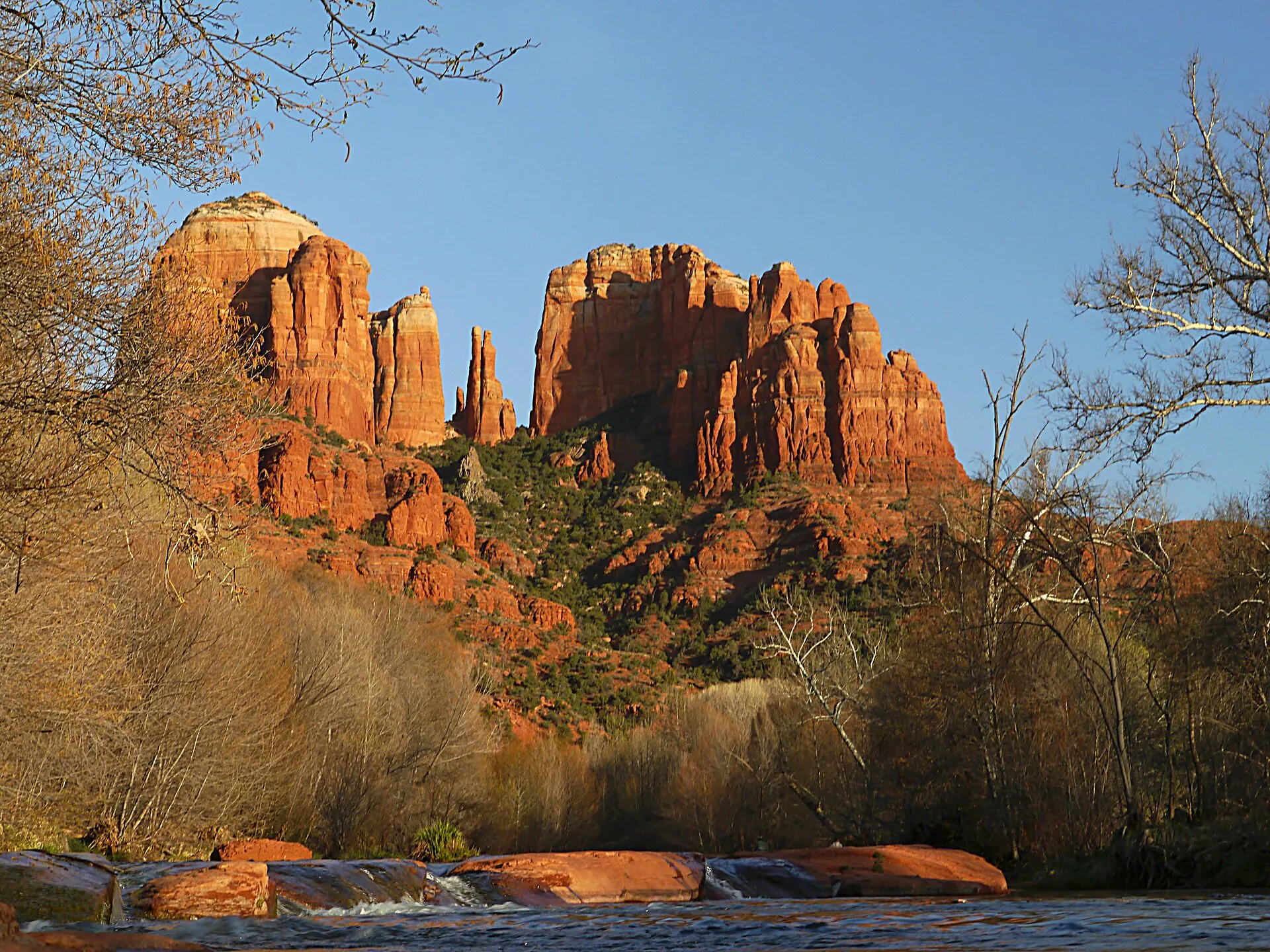
Red sandstone spires of Cathedral Rock glowing at sunset above Oak Creek, Sedona
TERRYDARC / WIKIMEDIA COMMONS / CC BY-SA 3.0

Sedona Vortexes

Sedona Energy Vortexes
FOLKLORE

Mainstream consensus: Sedona's redrock formations are a well-documented geological feature, Permian-age sandstone colored by iron oxide and shaped by erosion. No peer-reviewed study or instrument reading has measured an energy anomaly at any of the named vortex sites; the concept traces to one psychic's channeled claims in 1979-1980, not to physical evidence.

Share this page
Short answer

Sedona's vortexes are redrock sites, chiefly Airport Mesa, Bell Rock, Cathedral Rock, and Boynton Canyon, said to concentrate the earth's energy. A psychic named the spots in 1980 after a channeled vision. No instrument has ever measured an anomaly there; geologists credit the landscape's power to ordinary, well-documented sandstone erosion.

Location and access

Sedona's best-known vortex sites sit within the Coconino National Forest's Red Rock Ranger District, reachable from town on paved roads and maintained trails. Airport Mesa overlooks the valley from a knoll near the municipal airport, Bell Rock and Cathedral Rock rise on either side of State Route 179 south of town, and Boynton Canyon cuts northwest past the Enchantment Resort. Most trailheads require a Red Rock Pass or America the Beautiful Pass for parking, and the Forest Service maintains all four as ordinary public hiking destinations, vortex reputation included.

The dramatic red color comes from iron oxide in Permian-age Schnebly Hill sandstone, carved over millions of years by wind and water into the buttes, spires, and canyons that define the area. That geology is well documented and fully explains the landscape's visual power without any need for an unmeasured energy field.

History and legend

Sedona had already attracted a small community of metaphysically minded residents by the late 1950s, but the modern vortex concept took shape in 1979 and 1980, when psychic Page Bryant, temporarily living in town, described channeling an entity she called Albion. Albion, in her account, identified several redrock locations as points where the earth's life force was especially strong, which Bryant then named vortexes and began promoting through public workshops and tours. The term stuck even among skeptics of the idea: Pete Sanders, an MIT-trained author who leads his own vortex tours, has said plainly that the sites show no measurable electric or magnetic field, preferring to call them effective meditation locations instead.

The concept reached a much wider audience on August 16, 1987, when Sedona became one of the gathering points for the globally coordinated Harmonic Convergence, a synchronized meditation event that drew a large wave of visitors and cemented the town's reputation as a New Age pilgrimage destination. Decades of guidebooks, workshops, and tour operators have built on Bryant's original four sites since, even as no scientific instrument has ever detected the field those names describe.

Related places and beings

Sedona's vortex lore sits alongside Mount Shasta as one of the two most visited New Age pilgrimage sites in the American West, each pairing striking natural scenery with a modern spiritual legend layered onto older Indigenous land. The lost continent of Lemuria appears frequently in Sedona vortex literature, with some tour operators and authors describing the sites as surviving energy centers from that legendary civilization.

In popular culture

Sedona's vortex reputation has powered a steady tourism economy of guided hikes, crystal shops, and psychic readings since the 1980s, and the town regularly appears in travel features and New Age media as a place to feel the sites' claimed effects firsthand. Television specials and wellness retreats continue to use the vortex concept as a selling point, even as geologists and skeptical investigators point to the same explanation they have offered for decades: a genuinely striking landscape, shaped by ordinary erosion, with no instrument-detected energy to match the legend.

Photos and illustrations

Mix of rights-cleared documentary stills and AI illustrations (labeled).

Cathedral Rock at sunset, one of Sedona's most famous vortex sitesCredit: Terrydarc / Wikimedia Commons / CC BY-SA 3.0
Bell Rock, a bell-shaped butte often named as a vortex siteCredit: Tomascastelazo / Wikimedia Commons / CC BY-SA 4.0
Panorama from the vortex lookout near Airport MesaCredit: Liusheng79 / Wikimedia Commons / CC BY-SA 3.0
Illustrative scene for Sedona VortexesAI illustration for reference only

Visiting

loading map…

The four most-cited sites, Airport Mesa, Bell Rock, Cathedral Rock, and Boynton Canyon, sit on public land managed by the Coconino National Forest's Red Rock Ranger District. All are reachable by maintained trail or overlook, and a Red Rock Pass or America the Beautiful Pass is required for parking at most trailheads.

Legend vs history: Page Bryant's role in naming and popularizing the vortex sites starting in 1979-1980, and the subsequent growth of New Age tourism around them, is documented local history. The claim that these sites concentrate measurable energy has never been confirmed by any scientific instrument.

Reports and stories

Attributed reports, haunt claims, and discovery narratives from named sources. Links open the originals; AnomalyWiki does not verify these claims.

Claims vs mainstream

The claim

Airport Mesa, Bell Rock, Cathedral Rock, and Boynton Canyon concentrate measurable earth energy.

Mainstream view

No magnetometer or other instrument reading has detected an electric, magnetic, or electromagnetic anomaly at any of these sites beyond ordinary background variation.

The claim

The vortex concept is an ancient Indigenous teaching about this land.

Mainstream view

Historians trace the specific vortex sites and the term itself to psychic Page Bryant's 1979-1980 channeled identification of the locations; Yavapai and Western Apache sacred traditions regarding this land are distinct and predate the vortex concept.

The claim

Visitors can feel a distinct, location-specific energy at each named vortex.

Mainstream view

Researchers who have studied the sites, including one MIT-trained author who markets vortex tours, describe them as effective meditation spots whose psychological and sensory impact comes from the dramatic scenery, not from any measured physical field.

Timeline

  1. 1979-1980Page Bryant, describing a channeled encounter with an entity she called Albion, names several Sedona redrock locations vortexes and begins publicizing the concept through tours.Source: KJZZ, "Q&AZ: How did Sedona's vortex legend begin?"
  2. 1981Author Pete Sanders publishes "Scientific Vortex Information," describing the sites as meditative locations while noting the word "vortex" misleadingly implies a measurable physical field.Source: Sedona Red Rock News, "Sanders scientifically explains Sedona vortex sites"
  3. 1987-08-16The global Harmonic Convergence event draws a wave of visitors to Sedona, cementing the town's reputation as a New Age pilgrimage destination built around the vortex concept.Source: Los Angeles Times, "What's a vortex and do you have to visit Sedona to feel one?"

FAQ

What are the Sedona vortexes?

Natural redrock sites, chiefly Airport Mesa, Bell Rock, Cathedral Rock, and Boynton Canyon, that psychic Page Bryant named in 1979-1980 after describing a channeled vision of concentrated earth energy there.

Who named the Sedona vortexes?

Page Bryant, a psychic temporarily living in Sedona, credited an entity she called Albion with identifying the sites in 1979-1980, then publicized them through workshops and tours.

Has science confirmed any energy at the vortex sites?

No. No instrument reading has detected an electric, magnetic, or electromagnetic anomaly at any named site beyond ordinary background variation.

Why is Sedona's rock so red?

Geologists attribute the color to iron oxide in Permian-age Schnebly Hill sandstone, shaped over millions of years by erosion, a well-documented process unrelated to any claimed vortex.

Do the vortex sites require a permit to visit?

Most trailheads, including Boynton Canyon and Bell Rock, require a Red Rock Pass or America the Beautiful Pass for parking under the Coconino National Forest's fee program.