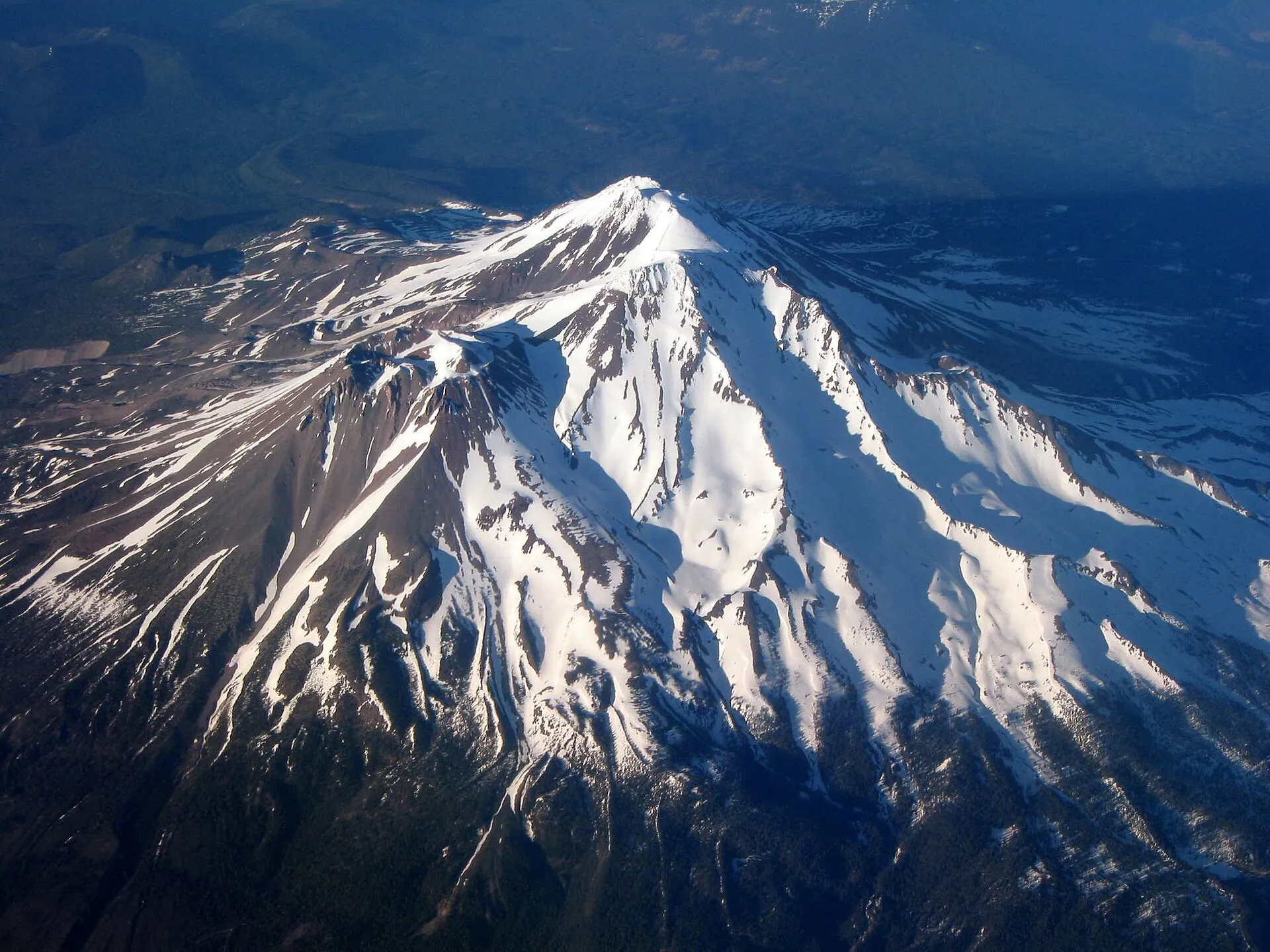
Location and access
Mount Shasta rises 14,162 feet in the southern Cascade Range of Siskiyou County, northern California, about 40 miles south of the Oregon border, at roughly 41.41 N, 122.19 W. The U.S. Forest Service manages most of the mountain within the Shasta-Trinity National Forest, and it stays open to hikers, climbers, and pilgrims year-round, with a permit required for summit attempts above timberline during the main climbing season.
Panther Meadow, a spring-fed alpine site partway up the mountain's south side, is co-managed with Wintu and other tribal representatives after a 1998 federal review found that a planned ski area expansion there would harm places of ongoing traditional and ceremonial use. Visitors are asked to stay on marked trails, avoid disturbing offerings, and respect any posted closures near ceremonial sites; nothing on the mountain requires special clearance beyond standard wilderness permits.
History and legend
USGS geologists classify Mount Shasta as a compound stratovolcano built from four separate cone-building episodes, with Holocene-era eruptions as recently as about 9,500 years ago at the Black Butte dacite domes, whose pyroclastic flows traveled more than six miles. The mountain carried deep spiritual meaning for the Wintu, Shasta, Karuk, and Pit River peoples long before any outside visitor arrived; Wintu tradition names it Bohem Puyuk, "Great Peak," and some tellings describe a spirit called Mis Misa dwelling within it, holding the balance of the world.
The hidden-city legend most tourists know today has a much younger, non-Native source. Frederick Spencer Oliver, a writer from nearby Yreka, claimed to have channeled a manuscript called "A Dweller on Two Planets," completed in the 1880s and published after his death in 1905. The book described an underground Lemurian temple-city beneath the mountain, filled with Atlantean survivors and impossible technology. Literary historians consider it weak as fiction but foundational as myth: it supplied nearly every element of the modern Shasta mythos and went on to influence the "I AM" movement and the Lemurian Fellowship. In 1998, decades after that legend took hold, a Forest Service review protecting Panther Meadow's documented tribal significance became one of the first cases to block a major development specifically because of harm to a Native American traditional cultural landscape.
Related places and beings
Mount Shasta anchors the West Coast end of America's New Age sacred-geography map, alongside Sedona's vortex sites in Arizona and the secret-base lore of Area 51 and Skinwalker Ranch. The lost continent most often credited with the mountain's inner city is Lemuria, the Pacific "sunken continent" idea that predates Oliver's novel but gained its most famous address once he placed it beneath Shasta's summit.
In popular culture
Mount Shasta has drawn pilgrims, UFO watchers, and self-described Lemurian contactees since the early twentieth century, and the nearby town leans into that reputation with crystal shops and channeling retreats built around the Telos legend. Writers from Guy Ballard's 1930s "I AM" movement to later New Age authors kept adapting Oliver's fictional underground city into new spiritual movements, each claiming its own lineage back to Lemuria. The mountain's genuine volcanic power and its documented tribal significance tend to get lost in that retelling, overshadowed by a hidden city nobody has ever found.


