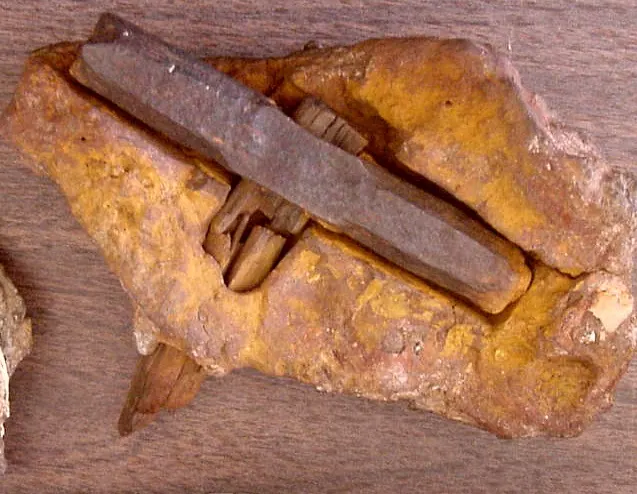
The London Hammer: a rusty iron hammerhead with a broken wooden handle stub, encased in a split nodule of orange-brown rock.
S. J. MIBA / WIKIMEDIA COMMONS / CC BY-SA 4.0

London Hammer

London Artifact · Texas Hammer
MISIDENTIFICATION

Mainstream consensus: A 19th- or early 20th-century mining or prospecting tool naturally encased by a geologically recent mineral concretion; not evidence against conventional geological dating.

Share this page
Short answer

The London Hammer is a 19th-century iron hammer head encased in a lump of rock found near London, Texas, in 1936. Geologists explain the concretion as mineral-rich creek water precipitating around the tool over decades, not millions of years. Similar modern objects have turned up encased in the same creek bed.

Mainstream view

Geologists identify the surrounding stone as a concretion, a common process in which minerals dissolved in groundwater precipitate around a nucleus object relatively quickly under the right chemistry - not a sign that the embedded object shares the age of the surrounding geological formation.

Alternative claim

Young-earth creationist promoters, most prominently the Creation Evidence Museum, present the hammer as evidence that modern humans and tools existed alongside, or predate, rock layers mainstream geology dates to hundreds of millions of years old.

Near London, Texas, an iron hammer head partly enclosed in limestone became a creationist postcard: modern tool, “ancient” rock. Geologists describe mineral concretion around a nineteenth-century tool - mineral-rich water growing a crust - not a Paleozoic blacksmith shop sealed by miracle.

Photographs travel farther than thin-section reports. The tool looks dramatic in matrix; the matrix looks ordinary once concretion chemistry is on the table. Similar iron-in-concretion finds elsewhere show the chemistry is commonplace. Rarity in rhetoric is not rarity in geology.

Creationist lecture circuits prized the hammer because it photographed well beside dinosaur models. Persuasion by juxtaposition is not a lab method. Remove the poster board and the concretion story still stands on ordinary chemistry. Other OOPArt favorites - Ica stones, Acambaro figures - teach the same visual lesson: drama in matrix is not a chronology certificate.

Keep the London Hammer as a lesson in how fast a striking image becomes a worldview prop. The wonder is geological process and human credulity, not a time-traveling carpenter. A visitor who leaves curious about concretions before slideshow certainty has the right field kit.

Site museums and roadside displays will keep reprinting the dramatic photo. Ask for the mineralogy caption before the miracle caption, and the hammer becomes interesting again for the right reasons.

Roadside plaques that omit concretion chemistry are doing marketing, not mineralogy.

Collectors who buy “out-of-place” tools by mail order often inherit stories instead of dug contexts. Inheritance is not excavation. If the hammer teaches anything durable, it is to ask who poured the first mineral crust narrative and who poured the miracle narrative second.

Mineralogists and miracle lecturers disagree loudly; only one side publishes thin sections.

County historical notes that simply record a curious concretion are doing quieter work than national lecture circuits. Quiet catalogs age better. If you must keep the hammer on a weird-objects shelf, keep the mineralogy tag laminated beside it so the next visitor inherits both images.

Footnote wars over concretions are healthier than a single frozen miracle meme. Enjoy the odd matrix without promoting every mineral crust into a suppressed Paleozoic workshop. Wonder plus attribution is how the London Hammer stays a teaching fossil of credulity.

Photos and illustrations

Mix of rights-cleared documentary stills and AI illustrations (labeled).

The London Hammer specimen, iron head and wooden handle stub in a rock noduleCredit: S. J. Miba / Wikimedia Commons / CC BY-SA 4.0
Texas creek-bed atmosphere (AI illustration, not the real specimen)AI illustration for reference only

Key debates and stories

Attributed discovery narratives, debates, and claim histories from named sources. Links open the originals; AnomalyWiki does not verify these claims.

Claims vs mainstream

The claim

The surrounding rock is hundreds of millions of years old, so the hammer must be too.

Mainstream view

The concretion's age is independent of the much older sedimentary formation nearby; mineral nodules of this kind can form around any object, including a 20th-century tool, within a matter of decades under iron- and calcium-rich groundwater conditions.

The claim

The hammer's handle shows partial fossilization impossible for a recent object.

Mainstream view

The visible dark coloration and texture are consistent with wood fragment carbonization and coal infiltration, a quicker process than fossilization and documented in other objects found in the same creek bed.

The claim

Mainstream science refuses to study the hammer, hiding the find.

Mainstream view

Independent researchers, including investigator Glen Kuban, have physically examined and metallurgically assessed the hammer and published their findings, describing a head consistent with common 19th-century mining tool design.

Timeline

  1. 1934Max and Emma Hahn report finding a rock with wood protruding from it along Red Creek near London, Texas.Source: Glen J. Kuban field investigation, paleo.cc
  2. 1947The rock is cracked open, revealing a metal hammer head embedded partway inside, after which the object begins circulating among creationist collectors.Source: Glen J. Kuban field investigation, paleo.cc
  3. 1980sCarl Baugh acquires the hammer for his Creation Evidence Museum and begins promoting it publicly as evidence against mainstream geological dating.Source: National Center for Science Education, "If I Had a Hammer"
  4. 1980s–2000sIndependent investigators including Glen Kuban examine the hammer's metallurgy and the surrounding creek bed, finding other modern objects encased in similar concretions and publishing a concretion-based explanation.Source: Glen J. Kuban field investigation, paleo.cc

FAQ

What is the London Hammer?

A corroded iron hammer head found partly embedded in a rock concretion near London, Texas, in the 1930s, now displayed at a private creationist museum in Glen Rose, Texas.

How old is the London Hammer?

The hammer head itself matches common 19th- or early 20th-century mining tool designs; the surrounding rock concretion likely formed within decades, not millions of years.

Why is the London Hammer encased in rock?

Mineral-rich groundwater can precipitate a hard concretion around an object relatively quickly under the right chemistry, a well-documented geological process unrelated to the age of nearby rock formations.

Has anyone examined the London Hammer scientifically?

Yes. Independent investigator Glen Kuban examined the hammer and surrounding creek bed directly, finding other modern objects encased in similar concretions nearby.

Where can I see the London Hammer?

It is on display at the Creation Evidence Museum in Glen Rose, Texas, a privately run young-earth creationist institution.