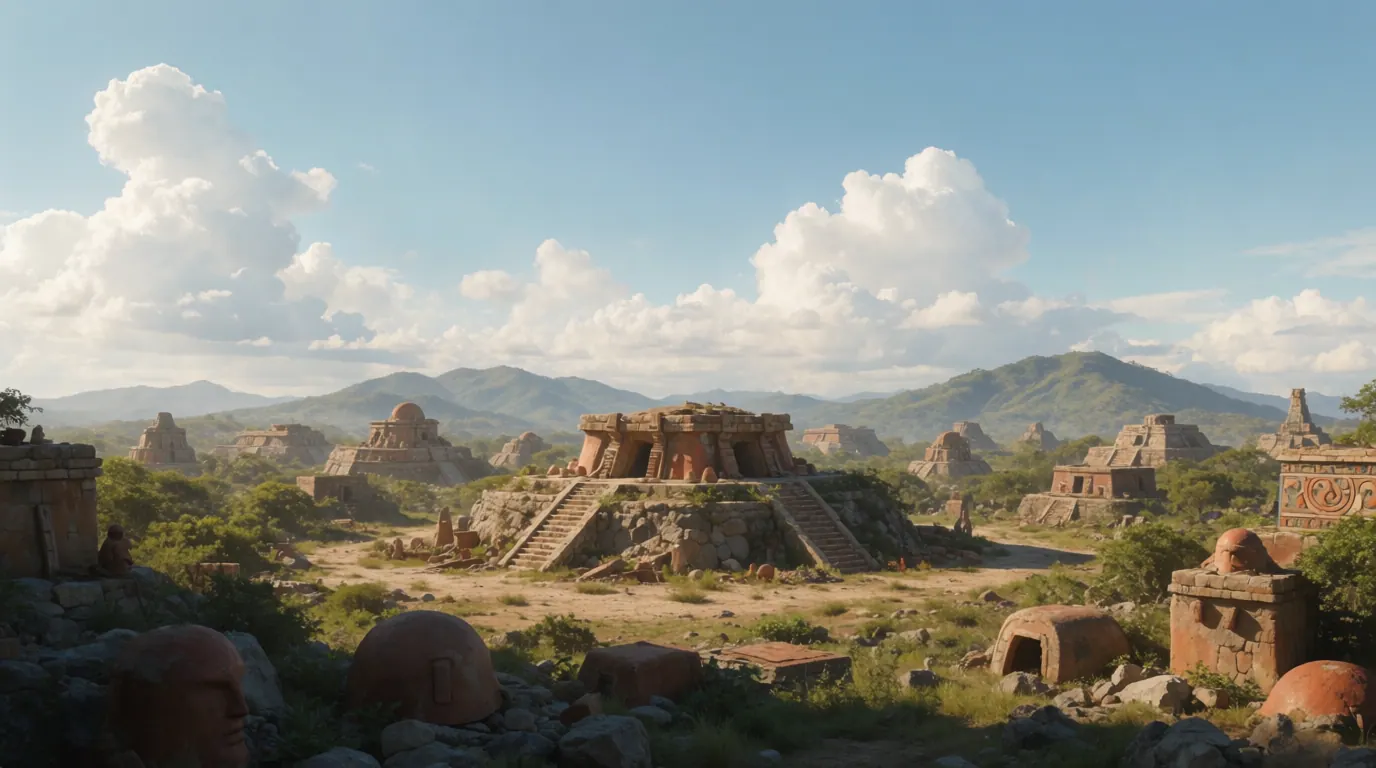
Barely the size of a thumb, a small terracotta head excavated at the Calixtlahuaca site in Mexico's Toluca Valley has quietly fueled one of Mesoamerican archaeology's more persistent "what if" debates. Archaeologist José García Payón recovered it in 1933 while excavating a burial offering, and he noted something striking at the time: the head's modeling, hairstyle, and facial features looked unmistakably Roman, closely matching figurine styles from the 2nd century CE - yet he reported finding it beneath three layers of apparently undisturbed pre-contact fill.
That combination is what makes the case interesting rather than simply dismissible. In 1999, researchers Romeo Hristov and Santiago Genovés revisited the object for the peer-reviewed journal Ancient Mesoamerica, pairing its clearly Roman stylistic match with thermoluminescence dating results and García Payón's stratigraphic notes to argue the head represents genuine evidence of a pre-Columbian transatlantic contact - Roman material reaching Mesoamerica roughly a millennium before Columbus, whether through direct voyage, drift, or an intermediary chain no one has documented.
The rebuttal came quickly and from within the same scholarly venue. In 2001, Peter Schaaf and Günther Wagner published a direct response in Ancient Mesoamerica, challenging the reliability of decades-old excavation records for ruling out post-contact disturbance. Small, dense ceramic objects can migrate through soil via rodent activity, subsequent digging, or simple storage-era mislabeling in ways 1930s excavation methods weren't equipped to detect or rule out. Their argument wasn't that the head is fake - its Roman styling isn't seriously disputed - but that a single portable artifact, excavated under early-20th-century standards, is thin ground for overturning the broader archaeological record's silence on transatlantic Roman contact.
Neither side has produced a knockout blow, which is exactly why Mesoamerican archaeologists generally treat the case as open but leaning skeptical rather than settled. The head sits in an unusual category: an object almost nobody doubts is authentically Roman, discovered somewhere almost nobody doubts is a real pre-contact Mesoamerican site, with the entire dispute hinging on a question - exactly how and when did it get there - that 1933-era fieldwork simply wasn't built to answer with certainty.