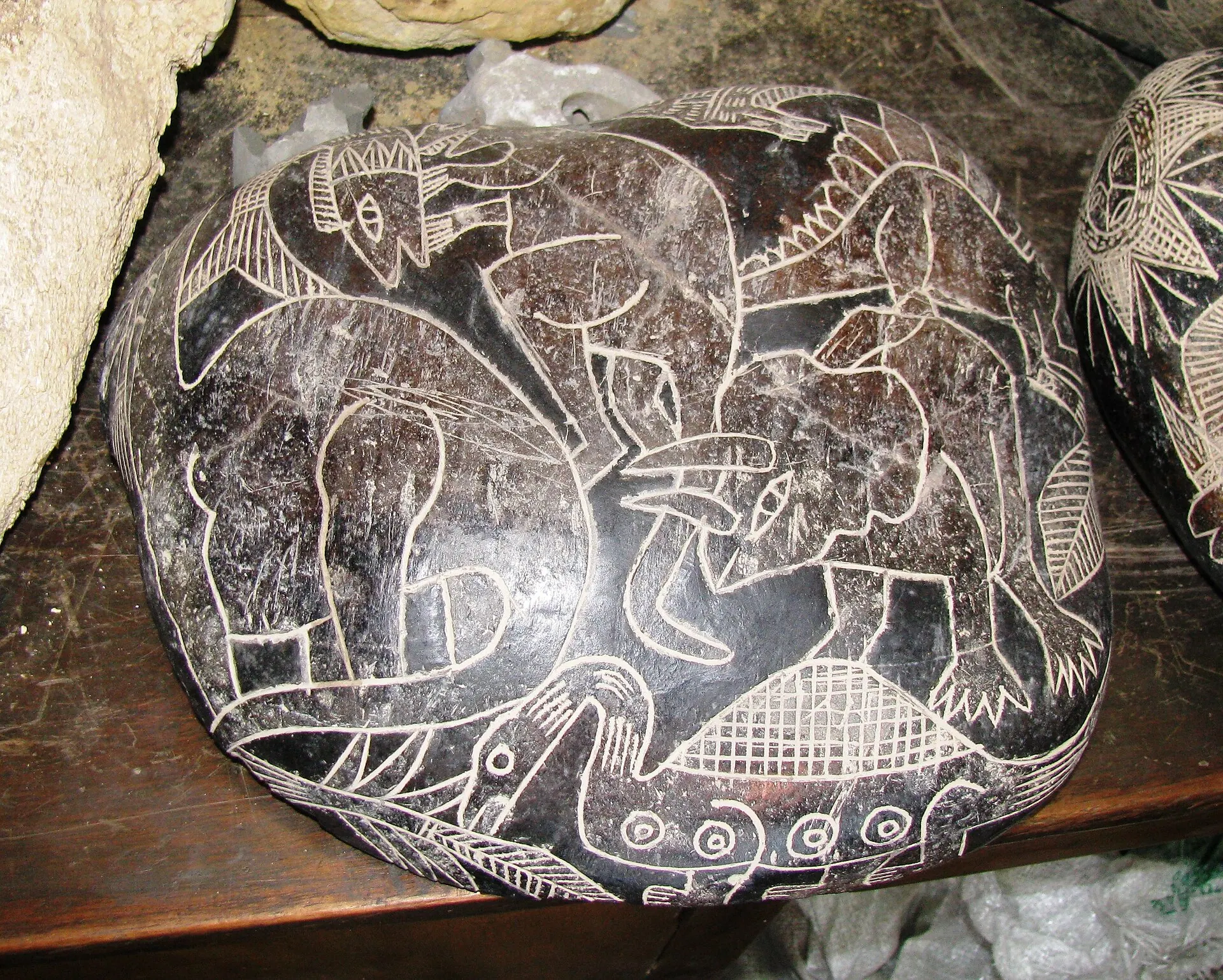
Andesite boulders carved with dinosaurs, star charts, and scenes of open-skull surgery began showing up in the Peruvian market town of Ica during the 1960s. Dr. Javier Cabrera Darquea, a local physician, became their most enthusiastic buyer and interpreter, eventually assembling more than ten thousand pieces and arguing they were the library of a vanished super-civilization that had tamed dinosaurs and mastered neurosurgery. He opened a private museum to display the collection and self-published his theories, and the stones quickly became a staple of ancient-astronaut television.
The case against them arrived with unusual clarity. In 1973, Peruvian police arrested a farmer named Basilio Uschuya for selling archaeological artifacts without authorization - a serious charge under Peru's heritage laws. Facing prosecution, Uschuya told investigators the stones were his own work and demonstrated the method on camera: sketching a design, carving it with a dentist's drill or similar tool, then aging the fresh cuts with boiled dirt or shoe polish so the lines looked weathered. He said he and several neighbors had been supplying dealers, and eventually Cabrera himself, for years. Reducing the charge against him, he reportedly told reporters it was easier to admit forgery than face prison for looting.
That confession lines up with everything else investigators found. No Ica stone has ever come from a documented excavation; all of them simply appeared in the market or in Cabrera's hands. The engraving style stays suspiciously consistent across supposed centuries and cultures, and the dinosaur depictions resemble the kind of illustrations found in mid-20th-century books and magazines rather than any pre-Columbian artistic convention. Skeptical investigators, including Joe Nickell writing for Skeptical Inquirer, found the stones' tool marks and patina fully consistent with recent manufacture under magnification.
Cabrera never recanted, and his museum still operates in Ica today, a monument to how far a determined true believer and a cottage industry of local carvers can take a story. The Ica stones sit comfortably alongside the Acámbaro figures as a case where mainstream archaeology's answer - modern forgery for profit - arrived early, on the record, and from the forgers' own mouths, yet the "lost civilization" reading keeps finding new audiences anyway.
