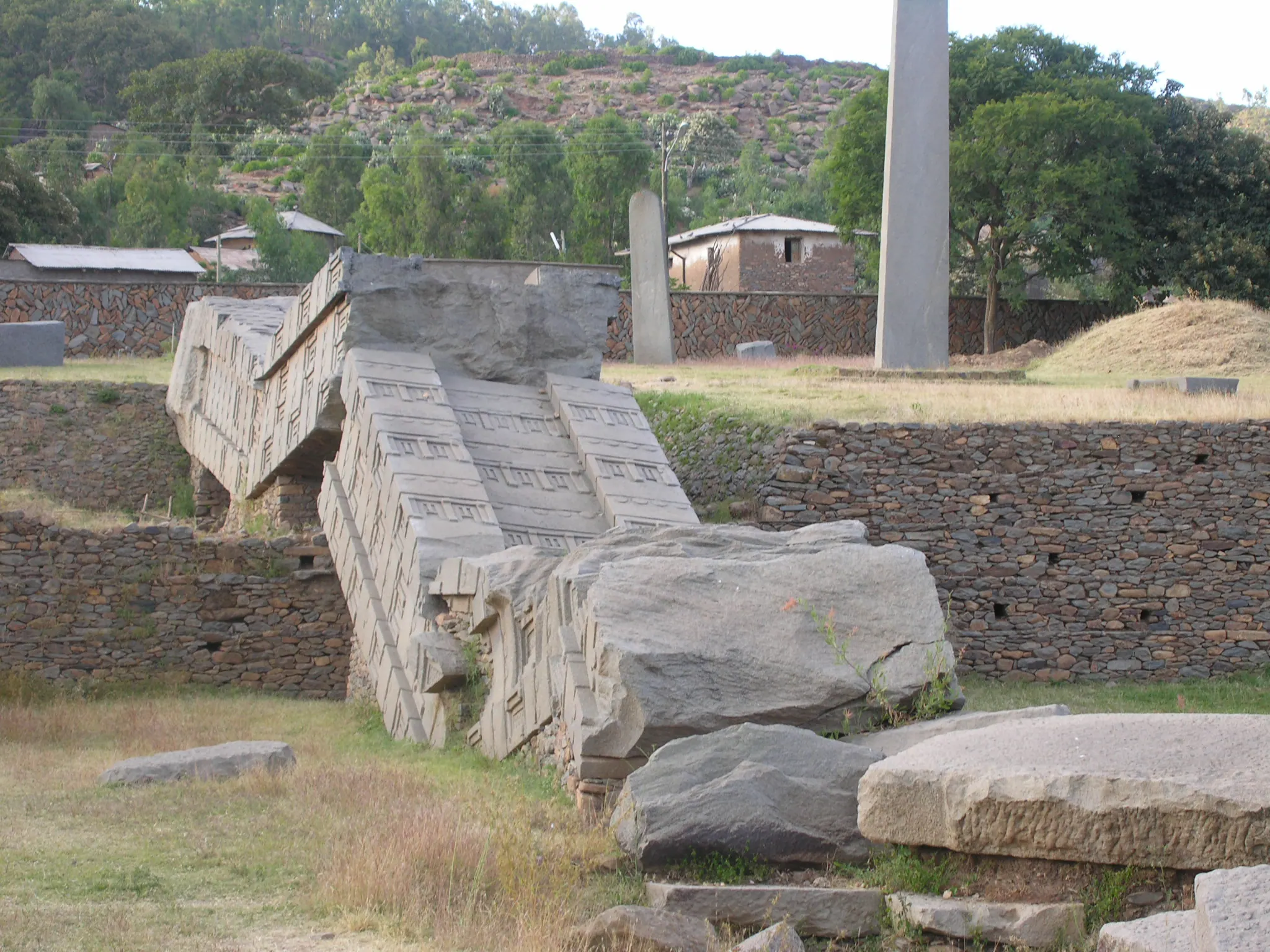
One of Aksum's carved granite stelae standing in the Northern Stelae Park, Ethiopia.
WIKIMEDIA COMMONS CONTRIBUTOR (CC BY-SA 3.0 IGO)

Kingdom of Aksum

Aksumite Empire · Axum
ARCHAEOLOGICAL

Mainstream consensus: Extensively excavated literate trading empire with its own coinage, script, and monumental architecture; a major ancient African power documented in multiple civilizations' records.

Share this page
Short answer

Aksum was a Horn of Africa trading kingdom famed for towering granite stelae, Red Sea commerce, and early Christian kingship under rulers like Ezana. Archaeology documents a real African empire at the highland capital - not an Atlantis colony or alien quarry.

Mainstream view

Aksum was a literate, coin-minting trading empire that controlled Red Sea commerce between the Roman Mediterranean, Arabia, and the Indian Ocean, adopted Christianity under King Ezana around 330 CE, and declined over centuries as trade patterns and regional power shifted southward.

Alternative claim

Ethiopian tradition (the Kebra Nagast) holds that the Ark of the Covenant rests in Aksum, brought by Menelik I, son of Solomon and the Queen of Sheba - a sacred claim distinct from and not dependent on the archaeological trading-empire record.

Aksum ran one of antiquity's great trade corridors from a highland capital most outsiders never visited. Its port of Adulis, described in the 1st-century Greek merchant's guide known as the Periplus of the Erythraean Sea, moved ivory, gold, and exotic goods between the Roman Mediterranean, Arabia, and the Indian Ocean world - commerce substantial enough that Aksum started minting its own gold, silver, and bronze coinage around 270 CE, a rarity among ancient African states and a sign of serious economic weight.

The stelae field tells the same story in stone. Dozens of carved granite monuments, including a felled giant once standing roughly 33 meters tall, mark royal burials in the Northern Stelae Park. Quarry marks and a continuous Ge'ez-script building tradition point to Aksumite engineers working with local knowledge, not imported expertise - monumental ambition built at home.

King Ezana's inscribed stela captures a hinge moment in world religious history mid-sentence: the same monument shifts from pagan to Christian language partway through, documenting his conversion around 330 CE as it happened. That made Aksum one of the earliest states anywhere to adopt Christianity as official policy, decades before Rome's own imperial turn.

Ethiopian Orthodox tradition adds a separate, sacred layer - the Kebra Nagast holds that the Ark of the Covenant has rested in Aksum since Menelik I, son of Solomon and the Queen of Sheba, brought it there. That belief sits in its own category of faith and tradition, distinct from the coins, inscriptions, and trade records that document Aksum's political history.

Peers in monumental African political power include Great Zimbabwe farther south, and comparison megalithic sites like Baalbek for sheer stone-raising ambition elsewhere in the ancient world. The licensed stelae photo belongs here because that granite is Aksum's clearest surviving argument for its own engineering.

Aksum's fade from regional dominance after roughly 700 CE tracks shifting Red Sea trade patterns and rising neighbors rather than any single dramatic ending - ordinary imperial decline, documented in coins and inscriptions rather than myth.

Documentary photos

Rights-cleared documentary stills and serious reference images. These are not AI illustrations.

Aksumite stelae, Northern Stelae ParkCredit: Wikimedia Commons contributor (CC BY-SA 3.0 IGO)

Key debates and stories

Attributed discovery narratives, debates, and claim histories from named sources. Links open the originals; AnomalyWiki does not verify these claims.

Claims vs mainstream

The claim

Aksum is a legendary kingdom without solid archaeological grounding.

Mainstream view

Excavated stelae fields, royal tombs, minted coinage, and Ge'ez inscriptions make Aksum one of ancient Africa's best-documented trading empires.

The claim

The Ark of the Covenant's presence in Aksum is an established historical fact.

Mainstream view

This is a matter of religious tradition recorded in the Kebra Nagast; it sits outside archaeological verification and is treated separately from Aksum's documented trade history.

The claim

Aksum needed outside (non-African) builders for its stelae and architecture.

Mainstream view

Quarry marks, construction techniques, and a continuous Ge'ez-script building tradition point to local Aksumite engineering, consistent with other major African kingdoms.

The claim

Aksum collapsed suddenly from a single cause.

Mainstream view

Specialists point to a gradual, centuries-long decline tied to shifting Red Sea trade routes, environmental pressures, and the rise of regional rivals - not one dramatic event.

Timeline

  1. 1st century CEThe Periplus of the Erythraean Sea describes Aksum's port of Adulis as a thriving Red Sea trade center.Source: Periplus of the Erythraean Sea
  2. c. 270 CEAksum begins minting its own gold, silver, and bronze coinage, a rarity among ancient African states.Source: Aksumite numismatic record
  3. c. 330 CEKing Ezana converts to Christianity, making Aksum one of the earliest states to adopt it officially.Source: Ezana Stone inscriptions
  4. c. 350 CEAksumite forces under Ezana campaign against the Kingdom of Kush, documented on inscribed stelae.Source: Ezana Stone and Aksumite royal inscriptions
  5. c. 700–940 CEShifting Red Sea trade routes and regional power changes drive a gradual decline of Aksumite dominance.Source: Aksumite decline scholarship

FAQ

What was the Kingdom of Aksum?

A Horn of Africa trading empire that minted its own coinage and controlled Red Sea commerce between roughly 100 and 940 CE.

Why are Aksum's stelae significant?

Dozens of carved granite stelae, including a fallen 33-meter giant, marked royal tombs and demonstrate sophisticated local monumental engineering.

When did Aksum adopt Christianity?

King Ezana converted around 330 CE, making Aksum one of the earliest states anywhere to adopt Christianity officially.

Is the Ark of the Covenant really in Aksum?

Ethiopian Orthodox tradition holds that it rests there, brought by Menelik I; this is a matter of sacred tradition, not archaeological verification.

Why did Aksum decline?

Shifting Red Sea trade routes, environmental pressures, and rising regional rivals drove a gradual decline over centuries rather than a single collapse.

Can you visit Aksum today?

Yes - the stelae field, royal tombs, and the Church of Our Lady Mary of Zion are open as a UNESCO World Heritage Site in northern Ethiopia.