Location and access
Socotra sits in the Arabian Sea between the Guardafui Channel and the Yemeni mainland, roughly 350 kilometers from the nearest coast. The island opened to easier outside access only in 2000, when its airport began operating; before that, ships were the only route in, and monsoon winds cut the island off entirely for months at a time.
Travel today depends heavily on regional security conditions, and tourist infrastructure outside the capital, Hadibu, remains limited. Most visitors arrive on organized trips that combine flights with local guides, since independent travel across the island's rugged interior is difficult without one.
History and legend
Socotra entered the written historical record early. The Periplus of the Erythraean Sea, a first-century-CE Greco-Roman merchant's guide, placed the island on the monsoon trade route under a frankincense-trading Arabian kingdom. Centuries later, Marco Polo's Travels described a Christian population answering to an archbishop in Baghdad rather than Rome, though translators note Polo never actually visited; he relied on sailors' accounts.
In 1507, a Portuguese fleet under Tristao da Cunha and Afonso de Albuquerque captured the port of Suq, hoping to use the island as a base against Muslim shipping to India. Famine, disease, and a poor natural harbor forced them out by 1511, after which the Mahra Sultanate regained control and the population returned to Islam. Classical writers also linked Socotra to the Phoenix bird's legendary nest, a literary flourish rather than a documented claim.
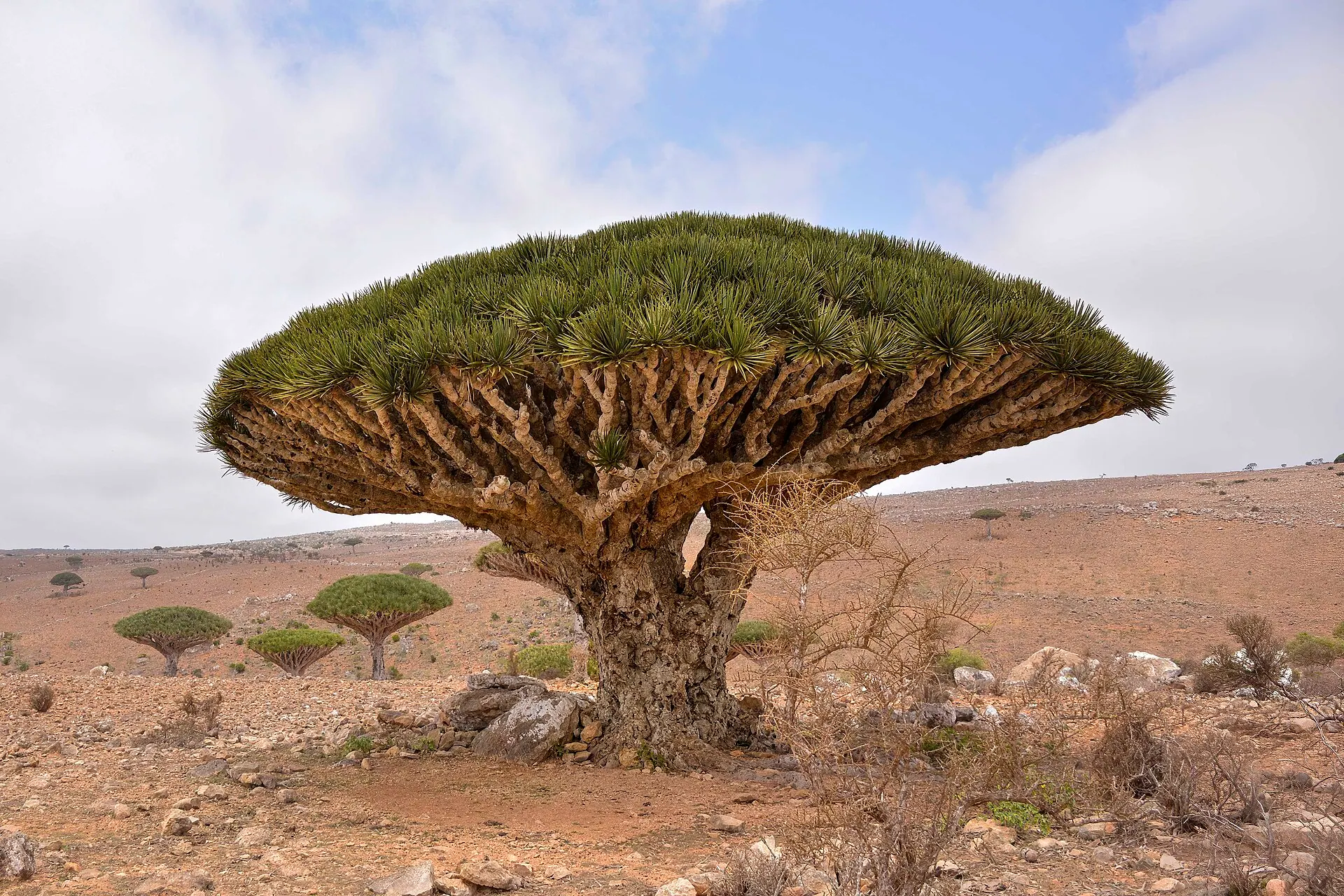
Socotra's reputation as an "alien" landscape rests on real, well-studied botany rather than any contested history. Dracaena cinnabari, the dragon's blood tree, is a Cenozoic relict of a once-continuous Mio-Pliocene subtropical forest that survived here after North Africa dried out and the rest of that forest disappeared elsewhere. UNESCO's 2008 inscription cites 37 percent endemism among the island's roughly 825 plant species, alongside 90 percent endemism in reptiles and 95 percent in land snails, a direct consequence of hundreds of thousands of years of isolation across open water with no mammalian grazers for most of that history. That isolation is now under pressure from overgrazing, overharvesting of marine resources, and unsustainable tourism, concerns UNESCO's own management guidance for the site flags directly.
Related places and beings
Socotra sits alongside other landscapes whose strangeness turns out to be explainable biology or geology rather than mystery: Zhangjiajie's sandstone pillars, the Danakil Depression's extreme chemistry, the Chocolate Hills, Pamukkale's terraces, and Waitomo's glowworm caves. Cross-category, Lemuria offers a pointed contrast: a popular 19th-century "lost continent" theory with no geological support, next to Socotra's independently dated and well-documented isolation history.
In popular culture
Nature photography and travel documentaries routinely frame Socotra as an "alien planet" backdrop, a label that has driven both tourism interest and some of the overgrazing pressure on the dragon's blood forests the island is famous for protecting. Socotra's marine life draws its own attention, with 253 reef-building coral species and 730 coastal fish species recorded in UNESCO's own assessment of the surrounding waters.


