Location and access
Zhangjiajie National Forest Park sits in the Wulingyuan District of Hunan province, China, part of a larger protected area that also includes Suoxi Valley, Tianzi Mountain, and Yangjiajie. The park entrance is at 279 Jinbian Road, open roughly 7:00 to 17:00 with last entry around 16:00.
The Bailong elevator, carved into a cliff face, and several cable cars carry visitors up to the main pillar overlooks without a full-day hike. The glass-bottomed Zhangjiajie Grand Canyon Bridge, a separate ticketed attraction nearby, opened in 2016 about 300 meters above a canyon floor.
History and legend
The land began as a state forest farm, replanted from 1958 to 1982 after earlier deforestation left the hills bare. China's central government approved it as the country's first national forest park on 25 September 1982, and in 1992 UNESCO inscribed the larger Wulingyuan Scenic and Historic Interest Area as a Natural World Heritage Site.
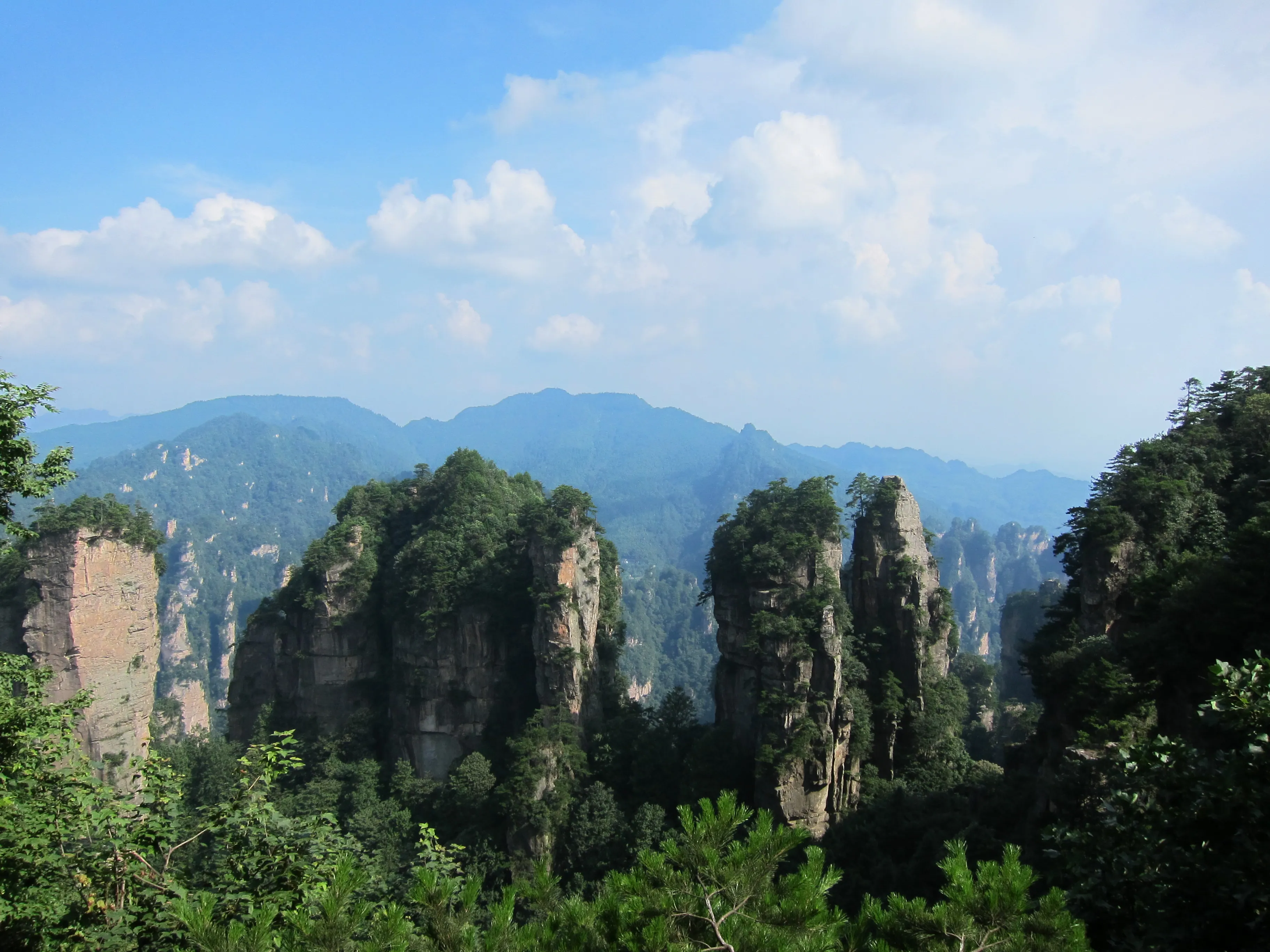
The site's most famous modern story is the 2010 renaming of the Southern Sky Column to Avatar Hallelujah Mountain. Zhangjiajie's tourism bureau said a photographer working on James Cameron's Avatar spent days in 2008 shooting the pillar for reference, and that those images shaped the film's floating "Hallelujah Mountains." Cameron himself told Chinese press he modeled the peaks on Huangshan Mountain in Anhui province; a Zhangjiajie park employee publicly countered that Huangshan is granite, while the film's towers visually match Zhangjiajie's quartz-sandstone pillars. Both claims still circulate side by side in press coverage.
Despite a karst-like silhouette, Zhangjiajie's pillars are not limestone karst at all. They are quartz sandstone shaped mainly by physical weathering: expanding ice in winter, roots forcing their way into cracks, and streams carrying weathered debris away, all working on rock that has stood through centuries of Chinese landscape painting long before any film reference existed. The 2010 renaming of the Southern Sky Column is a tourism-marketing decision layered on top of that real geological landmark, not evidence the site is anything other than well-documented sandstone erosion; local officials were explicit that the rename asserted Zhangjiajie's claim to the Avatar connection rather than imitating the film, a distinction that still drew domestic criticism at the time.
Related places and beings
Zhangjiajie sits alongside other landscapes where erosion alone produces scenery that looks engineered: Socotra's isolated flora, Pamukkale's travertine terraces, the Cave of the Crystals, and the Danakil Depression's extreme chemistry. Cross-category, the Richat Structure's Atlantis claim offers a useful contrast: a real eroded landform that attracts pseudo-archaeological "lost civilization" theories, much as Zhangjiajie attracts an "alien planet" label it never actually earned through anything but a film-marketing decision.
In popular culture
Since 2010, Zhangjiajie markets itself heavily around the Avatar connection, with "Pandora"-themed tours and signage throughout the Yuanjiajie scenic area. The pillars also appear regularly in Chinese landscape painting traditions that predate the film by centuries, a history local critics invoked when objecting to the rename, and the park now draws visitors who come specifically chasing the "Hallelujah Mountain" photo rather than the older Wulingyuan name on its own terms.


