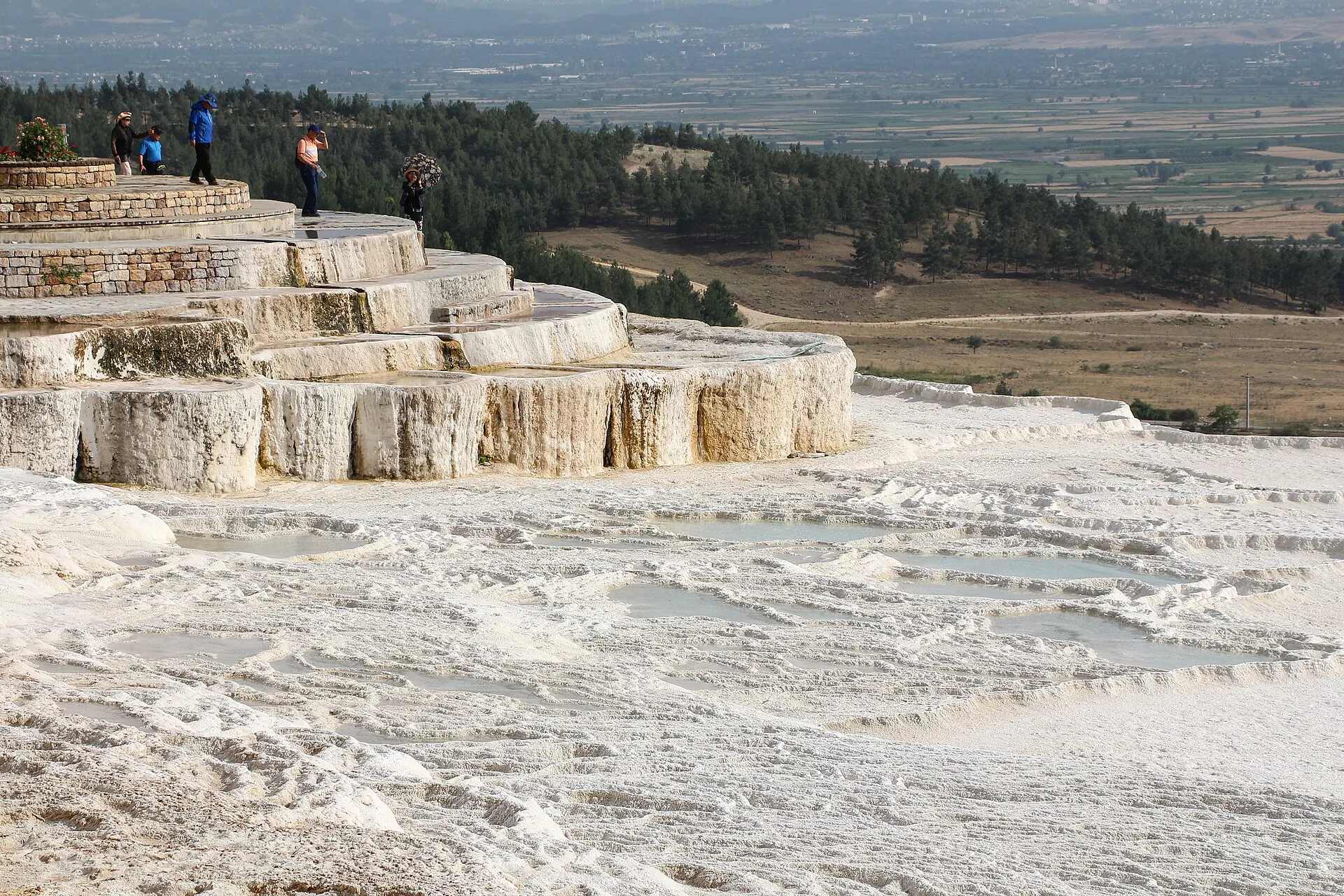
Location and access
Pamukkale sits in Denizli Province in southwestern Turkey, about 20 kilometers from the city of Denizli, with the travertine cliffs and the adjoining ruins of Hierapolis forming a single ticketed UNESCO World Heritage site. The site is open year-round, and most visitors arrive via Denizli's airport or an intercity bus connection, followed by a short local transfer.
Entry requires a ticket, and site rules ask every visitor to remove their shoes before stepping onto the main white terraces to protect the fragile mineral surface from oil and grit carried in on footwear. Swimming is restricted to designated pools rather than the open terraces, with the ticketed Cleopatra's Antique Pool, scattered with submerged ancient column fragments, the most popular option for actually getting in the water.
History and legend
The travertine terraces themselves predate any human settlement by an enormous margin, with geological surveys tracing active calcite deposition back at least 400,000 years into the Pleistocene, driven by hot, mineral-saturated spring water that has never stopped flowing from a fault-controlled fissure system beneath the plateau. People arrived relatively recently by comparison. The Attalid kings of Pergamon founded Hierapolis as a thermal spa city directly beside the springs at the end of the 2nd century BCE, building on top of an already ancient cult site drawn by the same healing waters.
Hierapolis passed to Roman control in 133 BCE and reached its architectural peak in the 2nd and 3rd centuries CE, before Christianity transformed it into an important Eastern Roman bishopric, commemorated in part by a martyrium built for Saint Philip. The city's long relationship with the ground beneath it has not always been gentle: a major earthquake flattened much of Hierapolis in 60 CE, and a 2000 geological study found that recurring quake damage across the centuries tracks the exact same fault zone responsible for feeding the hot springs that made the city worth building in the first place.
Related places and beings
Pamukkale belongs to a small global set of travertine landscapes shaped by hot, calcium-rich water losing dissolved gas as it reaches open air, a list that also includes Italy's Tivoli deposits and Mammoth Hot Springs in Yellowstone, though geologists note Pamukkale displays morphological terrace varieties not documented at either of those better-known sites.
The pairing of ancient ruins with ongoing mineral deposition also invites comparison with Fly Geyser's much younger, far smaller travertine mounds in Nevada, since both sites show the same calcium-carbonate chemistry at wildly different timescales, one running for 400,000 years and the other for barely six decades.
In popular culture
Pamukkale's blinding white cliffs have appeared in travel photography and tourism marketing for Turkey for generations, frequently framed from the valley floor in the town of Denizli, where the formation is visible from roughly 20 kilometers away. Its UNESCO dual listing as both a natural wonder and an archaeological site has made it a staple stop on broader Aegean and Anatolian tour itineraries alongside sites like Ephesus.
The site's popularity has also made terrace conservation an ongoing public conversation in Turkey, since heavy foot traffic and, in past decades, unrestricted swimming contributed to visible wear on sections of the formation, prompting the current barefoot-path and designated-pool rules that now govern how visitors experience the terraces.


