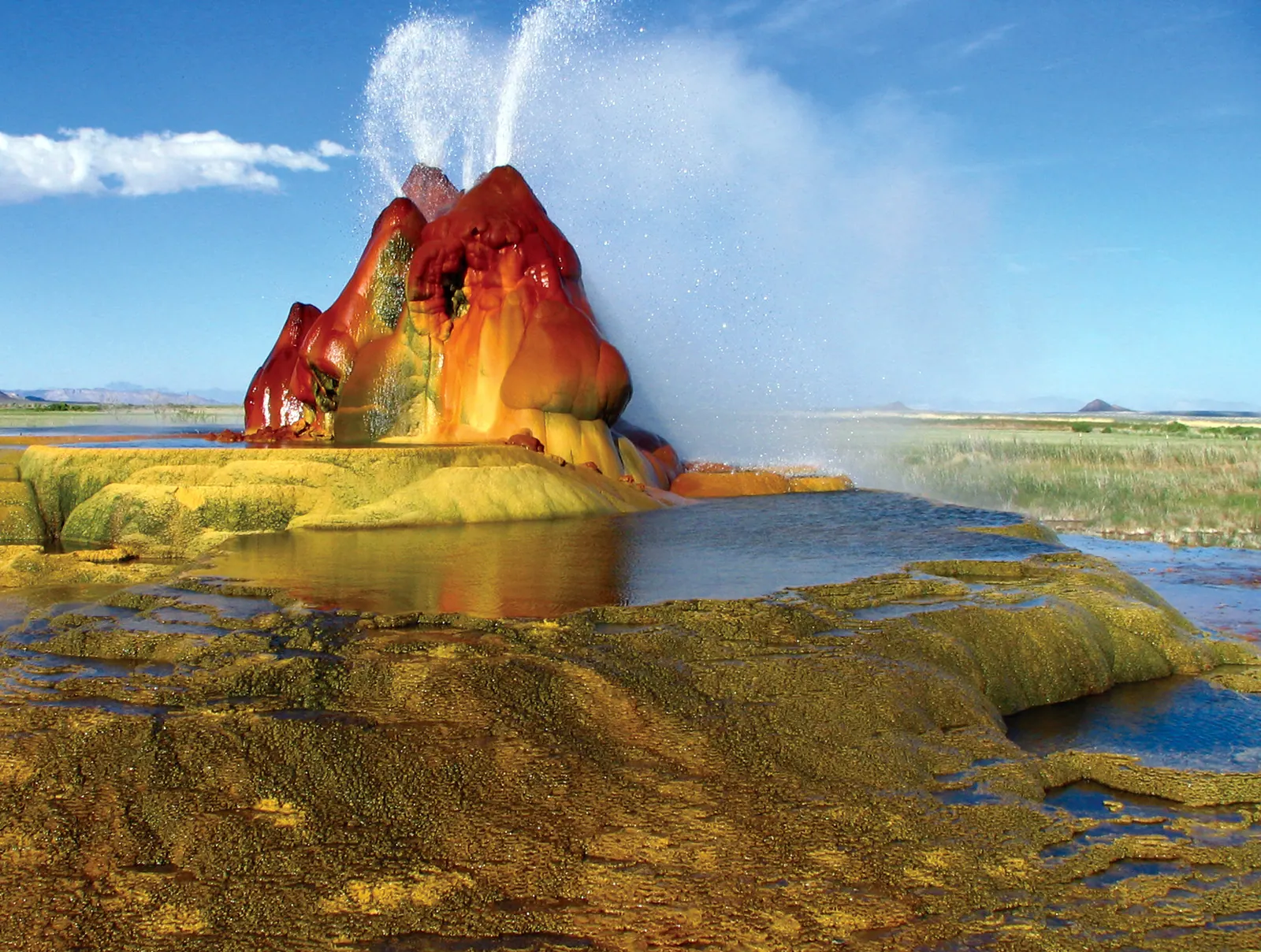
Fly Geyser mineral cones and terraces in the Nevada desert
JEREMY C. MUNNS / WIKIMEDIA COMMONS / PUBLIC DOMAIN

Fly Geyser

Fly Ranch Geyser
SCIENTIFICALLY EXPLAINED

Mainstream consensus: Fly Geyser is a confirmed accidental man-made feature. A 1964 geothermal-energy test well with an improperly sealed casing released pressurized, mineral-laden hot water that has flowed continuously since, building the cones and travertine terraces visible today.

Share this page
Short answer

Fly Geyser is a psychedelic, mineral-crusted mound in the Nevada desert that only exists because two separate well-drilling attempts, in 1916 and 1964, went wrong. A failed geothermal test well shot hot, mineral-rich water skyward and never stopped. The thermophilic algae painting it red and green is real biology; the geyser itself is entirely man-made plumbing.

Location and access

Fly Geyser sits on Fly Ranch, a roughly 3,800-acre property in Washoe County about 20 miles north of the small town of Gerlach, on the edge of Nevada's Black Rock Desert. The land has been privately owned since long before the geyser existed and remains so today under the nonprofit Burning Man Project, which bought the ranch in 2016.

There is no independent public access. Guardians remain on the property year-round, and trespassing is explicitly prohibited. The only legal way to see the geyser is a Fly Ranch Nature Walk, a guided tour run by Friends of Black Rock-High Rock that checks in at their visitor center on Main Street in Gerlach before driving the short distance out to the ranch, typically on select Saturdays between spring and fall.

History and legend

The geyser's origin story runs through two separate drilling mistakes rather than any ancient legend. In 1916, a well drilled in search of irrigation water for the surrounding ranchland struck geothermal water close to boiling instead. With no use for scalding water, the well was abandoned, and mineral deposits slowly built a calcium carbonate cone over the following decades, a quiet, dry curiosity on an otherwise unremarkable patch of desert.

The feature most people picture today traces to 1964, when a geothermal-energy company drilled a second test well just a few hundred feet from the original, hoping to tap power-generation-grade heat. The water came back too lukewarm for their purposes, and newspaper reports from the period describe the well being capped and the seal failing shortly after. Pressurized, mineral-saturated water has discharged continuously ever since, starving the original 1916 cone of pressure while building the layered, multicolored mounds and travertine pools that now define Fly Geyser.

Related places and beings

Fly Geyser belongs to a small, distinctly modern category of natural wonders: landscapes built by accidental human intervention rather than ancient geology. Turkmenistan's Darvaza Gas Crater shares that exact origin story, a drilling operation gone wrong that created a permanent, unplanned attraction out of a resource nobody meant to tap in that way.

The geyser's mineral-built travertine terraces also echo Pamukkale's white cascades on a vastly compressed timescale, since Pamukkale's version of the same calcium-carbonate chemistry has had roughly 400,000 years to work rather than six decades, a useful contrast for understanding how fast or slow travertine can actually accumulate.

In popular culture

Photographs of Fly Geyser's layered red, green, and white mounds, often shot against Nevada sunsets, circulated widely on travel and photography blogs through the 2000s and 2010s, frequently without context about the site's man-made origin or its strictly private access. That gap between the viral image and the closed gate behind it became part of the geyser's mystique.

The Burning Man Project's 2016 purchase and subsequent 2018 reopening to limited guided tours turned the geyser into an official extension of the organization's broader art and ecology mission at Fly Ranch, pairing it with Land Art Generator Initiative installations and labyrinth walks rather than leaving it as an isolated roadside legend. The result is a landmark that is simultaneously extremely photographed and, for most people, never actually seen in person.

Photos and illustrations

Mix of rights-cleared documentary stills and AI illustrations (labeled).

Fly Geyser's multi-colored travertine cones on Fly RanchCredit: Jeremy C. Munns / Wikimedia Commons / Public domain
Mineral-crusted cones and thermophilic algae coloringCredit: RuggyBearLA / Wikimedia Commons / CC BY 2.0
Travertine terraces built by continuous geothermal dischargeCredit: RuggyBearLA / Wikimedia Commons / CC BY 2.0
Illustrative scene for Fly GeyserAI illustration for reference only

Visiting

loading map…

Fly Geyser sits on private land owned by the nonprofit Burning Man Project and cannot be visited independently; trespassing is not permitted. The only legal access is a guided Fly Ranch Nature Walk, run by Friends of Black Rock-High Rock on select Saturdays from roughly March through November, checking in at their visitor center at 320 Main Street in Gerlach, Nevada.

Legend vs history: Every stage of Fly Geyser's origin is documented well-drilling history rather than legend: a 1916 irrigation well, a second 1964 geothermal test well with a failed seal, and the resulting continuous discharge that built today's travertine mounds. There is no older folklore layer to separate out, only confusion in popular media over which well created which feature.

Reports and stories

Attributed reports, haunt claims, and discovery narratives from named sources. Links open the originals; AnomalyWiki does not verify these claims.

Claims vs mainstream

The claim

Fly Geyser is a fully natural geological formation like Yellowstone's geysers.

Mainstream view

Both of the site's geysers trace directly to human drilling, in 1916 and 1964. Geologists classify it as an anthropogenic geothermal feature, distinct from natural geyser fields that form without any well intervention.

The claim

The geyser's vivid red and green colors come from chemical pollution or dye.

Mainstream view

The coloring comes from thermophilic algae and cyanobacteria that thrive in the hot, mineral runoff, the same biological process that colors terraces at Yellowstone, not any artificial additive or contamination.

The claim

Fly Geyser has been a well-known tourist site for most of the 20th century.

Mainstream view

The site sat on private ranchland largely unknown to the public for decades; the Burning Man Project only purchased Fly Ranch in 2016 and began offering any limited public access in 2018.

The claim

Anyone can hike out and see the geyser for free, since it is in the open desert.

Mainstream view

Fly Ranch is private property with on-site guardians, and open access is explicitly prohibited. The only sanctioned way to see the geyser is a paid, guided nature walk booked in advance through Friends of Black Rock-High Rock.

Timeline

  1. 1916A well drilled while searching for irrigation water strikes near-boiling geothermal water; the well is abandoned and a 10-to-12-foot calcium carbonate cone forms over it.Source: Wikipedia, "Fly Geyser"
  2. 1964A geothermal-energy company drills a second test well nearby. The water is too cool for power generation, and the company reportedly caps the well, but the seal fails, releasing a new geyser that draws pressure away from the original and leaves it dry.Source: GeologyPage.com; Wikipedia, "Fly Geyser"
  3. 1964-presentContinuous discharge from the failed 1964 well deposits calcium carbonate and silica, slowly building the geyser's distinctive multi-mound travertine formation still growing today.Source: Wikipedia, "Fly Geyser"
  4. June 2016The nonprofit Burning Man Project purchases the 3,800-acre Fly Ranch, including the geyser, for 6.5 million dollars, preserving it as a sanctuary rather than developing it.Source: Wikipedia, "Fly Geyser"; flyranch.burningman.org
  5. May 2018Burning Man Project begins offering the public limited guided access to Fly Ranch for the first time in roughly two decades, through scheduled nature walks.Source: KUNR, "Fly Geyser Opens To Public For First Time In Two Decades"

FAQ

Is Fly Geyser a natural formation?

No. Both of its geysers trace to human well-drilling, an irrigation well in 1916 and a geothermal test well in 1964 whose failed seal created the geyser visible today.

Why is Fly Geyser so colorful?

The red and green hues come from thermophilic algae and cyanobacteria that thrive in the hot, mineral-rich runoff, similar to the biology coloring Yellowstone's hot springs.

Can the public visit Fly Geyser?

Only through a guided Fly Ranch Nature Walk booked through Friends of Black Rock-High Rock, typically offered on select Saturdays from spring through fall. Independent access is prohibited since the land is privately owned.

Who owns Fly Geyser today?

The nonprofit Burning Man Project has owned the 3,800-acre Fly Ranch, including the geyser, since purchasing it for 6.5 million dollars in June 2016.

How tall is Fly Geyser?

The active mound stands roughly 5 feet tall and 12 feet wide including its base, and it has grown gradually since 1964 as mineral-rich water continues depositing calcium carbonate and silica around it.