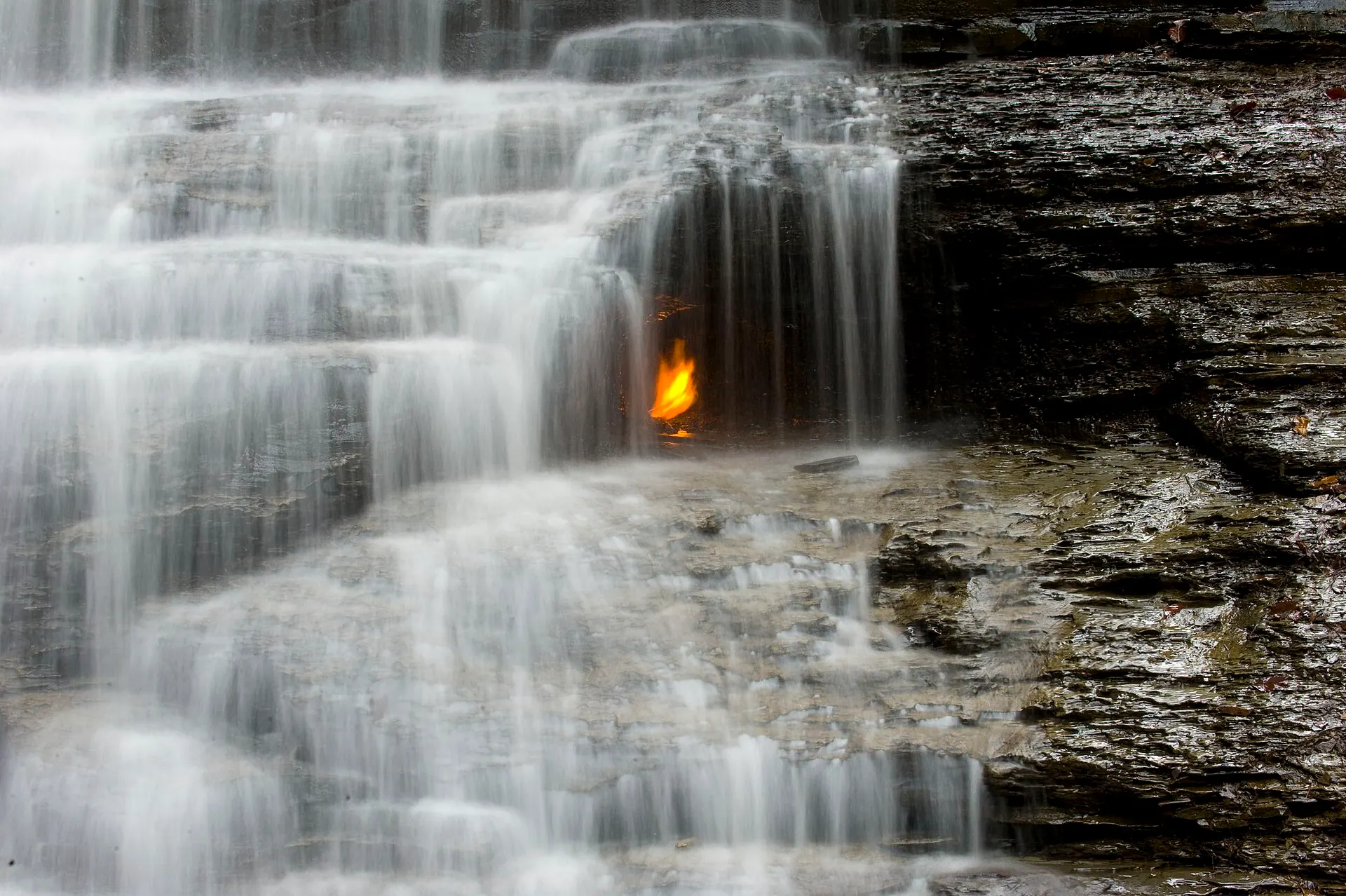
Eternal Flame Falls waterfall with natural gas flame
MPMAJEWSKI / WIKIMEDIA COMMONS / CC BY-SA 3.0

Eternal Flame Falls

Shale Creek Eternal Flame
SCIENTIFICALLY EXPLAINED

Mainstream consensus: Eternal Flame Falls is a verified natural gas macroseep. A 2013 Marine and Petroleum Geology study found the gas is dominantly thermogenic, likely migrating from the Upper Devonian Rhinestreet Shale roughly 400 meters deep through tectonic fault pathways, with unusually high ethane and propane content for a natural seep.

Share this page
Short answer

Eternal Flame Falls, in New York's Chestnut Ridge Park, hides a grotto where natural gas seeps from shale and can be lit behind a waterfall curtain. A 2013 study traced the gas to Devonian shale 400 meters down, with unusually high ethane and propane. The flame is real; it just occasionally needs relighting.

Location and access

The falls sit inside the Shale Creek Preserve section of Chestnut Ridge Park in Orchard Park, a suburb of Buffalo in Erie County, New York. Hikers reach them via the Eternal Flame Trail, a 0.56-mile, moderately difficult descent from the official trailhead parking lot on Route 277, which has restrooms, trail maps, and benches.

The path winds under hemlock, maple, and pine before dropping into a steep ravine, with the final stretch requiring some creek-walking along Shale Creek to reach the waterfall's base. Erie County Parks added 139 box steps and roughly 120 feet of handrail along the steepest section in a 2023 renovation, but the department still asks visitors to wear sturdy, non-slip shoes and to never attempt to climb the ravine walls or the waterfall itself, since the rock is frequently wet and unstable.

History and legend

Nobody recorded exactly when locals first noticed gas seeping from the small grotto behind the falls and realized it could be lit; researchers who later studied it describe the flame as present "throughout available recorded history" in the area, with the underlying seepage potentially active for hundreds or even thousands of years given its stable deep-shale source. For most of that time it remained a quiet, little-known curiosity, visited mainly by local hikers who knew where to look.

That changed in 2013, when geologist Giuseppe Etiope, who had already studied eternal flames on several continents, led a team from Indiana University and Italy's National Institute of Geophysics and Volcanology in sampling the seep directly. Their geochemical analysis, comparing isotopes and gas composition against regional shale and reservoir data, traced the flame's fuel straight to the Upper Devonian Rhinestreet Shale roughly 400 meters below, rising through fault pathways carved by ancient tectonic stress rather than any human-made structure.

Related places and beings

Eternal Flame Falls belongs to a small global family of natural gas seeps that burn visibly at the surface, most of them far less accessible than this one. Turkmenistan's Darvaza Gas Crater runs on the same basic chemistry at a vastly larger and more violent scale, a desert pit rather than a quiet waterfall grotto, while sharing the same thermogenic-methane origin story.

The 2013 study that explained this flame also examined a lookalike site in Clarington, Pennsylvania, and found a genuinely different cause, gas leaking from an old, undocumented well rather than a natural shale seep, a useful reminder that two "eternal flames" can look identical while having completely different underground stories.

In popular culture

Once considered an obscure regional curiosity, Eternal Flame Falls gained steadily wider attention through outdoor-recreation media, hiking blogs, and social media photography over the 2000s and 2010s, which Wikipedia credits with driving a sharp rise in visitor numbers. That popularity brought real strain: increased litter, erosion, and even vandalism aimed at the flame itself prompted Erie County's 2023 trail and safety overhaul.

The site now functions as both a quietly famous photography destination and a small, accessible case study in applied geochemistry, regularly cited in science writing precisely because researchers could walk up, sample it directly, and publish a clear, peer-reviewed answer rather than leaving its cause as open folklore.

Photos and illustrations

Mix of rights-cleared documentary stills and AI illustrations (labeled).

Eternal Flame Falls in Chestnut Ridge ParkCredit: Mpmajewski / Wikimedia Commons / CC BY-SA 3.0
Natural gas flame behind the falling waterCredit: Rory Szwed / Wikimedia Commons / Public domain
Falls and grotto context at Chestnut RidgeCredit: Rory Szwed / Wikimedia Commons / Public domain
Illustrative scene for Eternal Flame FallsAI illustration for reference only

Visiting

loading map…

Reach the falls via the Eternal Flame Trail, a moderate 0.56-mile one-way hike from the official trailhead parking lot on Route 277 in Orchard Park, descending into a ravine and requiring some creek-walking near the end. Erie County Parks asks hikers to stay on the marked trail and not climb the ravine walls or waterfall itself; sturdy, non-slip footwear is strongly recommended.

Legend vs history: The flame, the waterfall, and the park are all documented and mapped; this is a well-known local hiking destination, not a disputed legend. The only genuine open question researchers raised was the gas's exact subsurface source and flow mechanism, which the 2013 study addressed directly.

Reports and stories

Attributed reports, haunt claims, and discovery narratives from named sources. Links open the originals; AnomalyWiki does not verify these claims.

Claims vs mainstream

The claim

The flame is a hoax maintained by hidden tanks or piping, since natural gas seeps this strong are too rare to be real.

Mainstream view

Researchers Giuseppe Etiope, Arndt Schimmelmann, and colleagues directly sampled the seep gas and measured its flux using portable detectors, finding roughly 1 kilogram of methane released daily along with nearby diffuse microseeps from the same geological source, consistent with a genuine natural seepage system.

The claim

The gas comes from a buried, forgotten oil or gas well rather than anything natural.

Mainstream view

Isotopic and molecular analysis tied the New York flame's gas directly to the deep Rhinestreet Shale without passing through a conventional reservoir. The same 2013 study found a comparable "eternal flame" in Pennsylvania likely does come from an abandoned well, showing researchers can and do distinguish the two cases.

The claim

The flame has burned continuously and without interruption for thousands of years.

Mainstream view

Researchers describe the seep as likely burning naturally "throughout available recorded history," possibly for hundreds or thousands of years, but acknowledge it is occasionally extinguished by wind, rain, or vandalism and must be relit by park visitors or staff.

The claim

The unusually high ethane and propane levels suggest contamination from nearby drilling activity.

Mainstream view

The study's authors identify the high ethane-propane content, roughly 35 percent of the gas, as a natural signature of direct shale-gas migration without passing through a conventional reservoir, making it scientifically notable rather than evidence of contamination.

Timeline

  1. Pre-20th centuryLocal accounts describe the flame as a known feature "throughout available recorded history," with researchers later estimating it may have burned naturally for hundreds or even thousands of years given its stable geological source.Source: Etiope et al., Marine and Petroleum Geology (2013)
  2. 2013Geologists from Indiana University and Italy's National Institute of Geophysics and Volcanology publish the first dedicated geochemical study of the seep, tracing its gas to the Rhinestreet Shale and measuring its flux and composition.Source: Etiope, Schimmelmann & Drobniak, Marine and Petroleum Geology (2013)
  3. 2013The same research team studies a second "eternal flame" in Clarington, Pennsylvania, and finds its gas likely migrates from a conventional sandstone reservoir through an undocumented, abandoned well rather than a natural shale seep.Source: Goldschmidt Abstracts (2013)
  4. August 2023Erie County Parks reopens the main Eternal Flame Trail after major renovation, adding 139 box steps and about 120 feet of railing to address erosion and visitor safety along the descent.Source: Wikipedia, "Eternal Flame Falls"

FAQ

What causes the flame at Eternal Flame Falls?

Natural gas, mostly thermogenic methane with an unusually high share of ethane and propane, seeps from a small grotto at the base of the falls and can be lit to burn, drawing from Devonian shale roughly 400 meters below the surface.

Does the flame ever go out?

Yes. Wind, heavy rain, or vandalism occasionally extinguish it, and visitors or park staff relight it with a lighter when that happens, so it is not literally continuous.

How do you get to Eternal Flame Falls?

Park at the official trailhead on Route 277 in Chestnut Ridge Park, Orchard Park, and follow the 0.56-mile Eternal Flame Trail down into the ravine, including some creek-walking near the end to reach the falls.

Is the gas at Eternal Flame Falls from a hidden pipe or hoax?

No. A 2013 peer-reviewed study measured the gas directly and traced it isotopically to deep shale, distinguishing it from a similar Pennsylvania flame the same researchers found likely comes from an abandoned well instead.

Why is this seep scientifically unusual?

It may have the highest combined ethane and propane concentration, around 35 percent of the gas, ever measured at a natural seep, and its gas appears to migrate directly from shale without passing through a conventional underground reservoir first.