Location and access
The cave sits roughly 300 meters below the surface inside the Naica lead, zinc, and silver mine near Saucillo, Chihuahua, reached historically through the mine's own tunnel network rather than any public entrance. Industrias Peñoles, the company that operates the mine, controlled all access during the window the cave was dry and studied.
Nobody can visit today. Once mining pumps stopped clearing groundwater from the deeper levels as operations wound down between roughly 2015 and 2017, the chamber refilled with the same mineral-saturated water that built the crystals in the first place. Even during its brief open period, entry required specialized cooling suits and strict time limits, since the chamber held temperatures near 58 degrees Celsius alongside near-total humidity that could kill an unprotected visitor within minutes.
History and legend
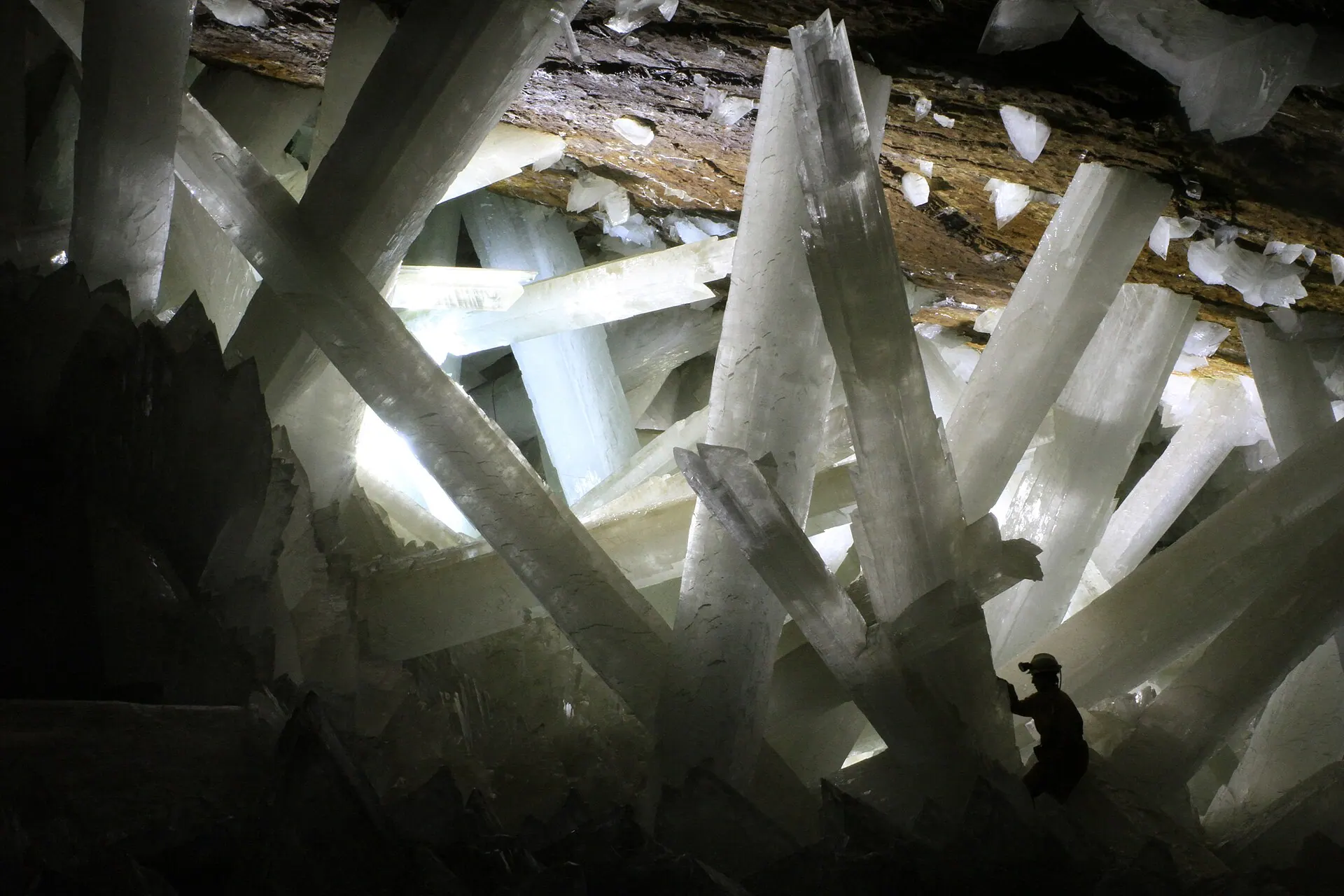
Naica's miners had encountered smaller crystal caves for most of a century before 2000, including the Cueva de las Espadas, found in 1910 and named for its meter-sized "sword" crystals. Nothing prepared anyone for what brothers Juan and Pedro Sanchez found in April 2000 while cutting a new tunnel roughly 300 meters down: a chamber lined floor to ceiling with translucent gypsum beams, some stretching 11 meters long, unlike anything recorded in any cave on Earth.
Crystallographer Juan Manuel Garcia-Ruiz led the scientific response, and his 2007 study in the journal Geology solved the puzzle by analyzing tiny pockets of ancient fluid trapped inside the crystals themselves. Those fluid inclusions showed the water sat remarkably close to 54 degrees Celsius, the precise point where gypsum and its mineral cousin anhydrite trade places in solubility, for what his nucleation calculations suggest was well over a million years in places. That narrow, stable window, not any exotic process, is why nowhere else on the planet has grown gypsum crystals this large.
Related places and beings
The Naica chamber belongs to a short list of places where ordinary geochemistry, given enough undisturbed time, produces something that looks engineered rather than grown. Pamukkale's travertine terraces work the same basic chemistry in reverse, with hot mineral water losing gas and depositing calcite instead of dissolving and redepositing gypsum, over a comparably patient timescale of hundreds of thousands of years.
The cave's buried, heat-sealed discovery story also pairs naturally with Darvaza's Door to Hell, another site where a hostile physical environment, methane fire in one case and lethal heat and humidity in the other, delayed firsthand human exploration by decades after the feature itself was already known to exist.
In popular culture
National Geographic photographer Carsten Peter's 2008 images of climbers dwarfed by beam-sized crystals became some of the most reproduced geology photographs of the decade, and the Discovery Channel built an entire 2011 documentary, "Naica: Beyond the Crystal Cave," around expeditions into the chamber. The cave also appeared on History Channel's Life After People and the travel series Angry Planet, usually framed as proof that nature can out-design science fiction.
Microbiologist Penelope Boston's announcement in 2017 that her team had revived ancient microbes trapped inside the crystals added a second wave of attention, feeding both legitimate astrobiology interest in Naica as an analogue for extremophile life elsewhere and looser online claims that overstate the microbes' age. The cave's reflooding that same year gave the story a bittersweet ending: the crystals are safe and will likely keep growing, just permanently out of reach again.


