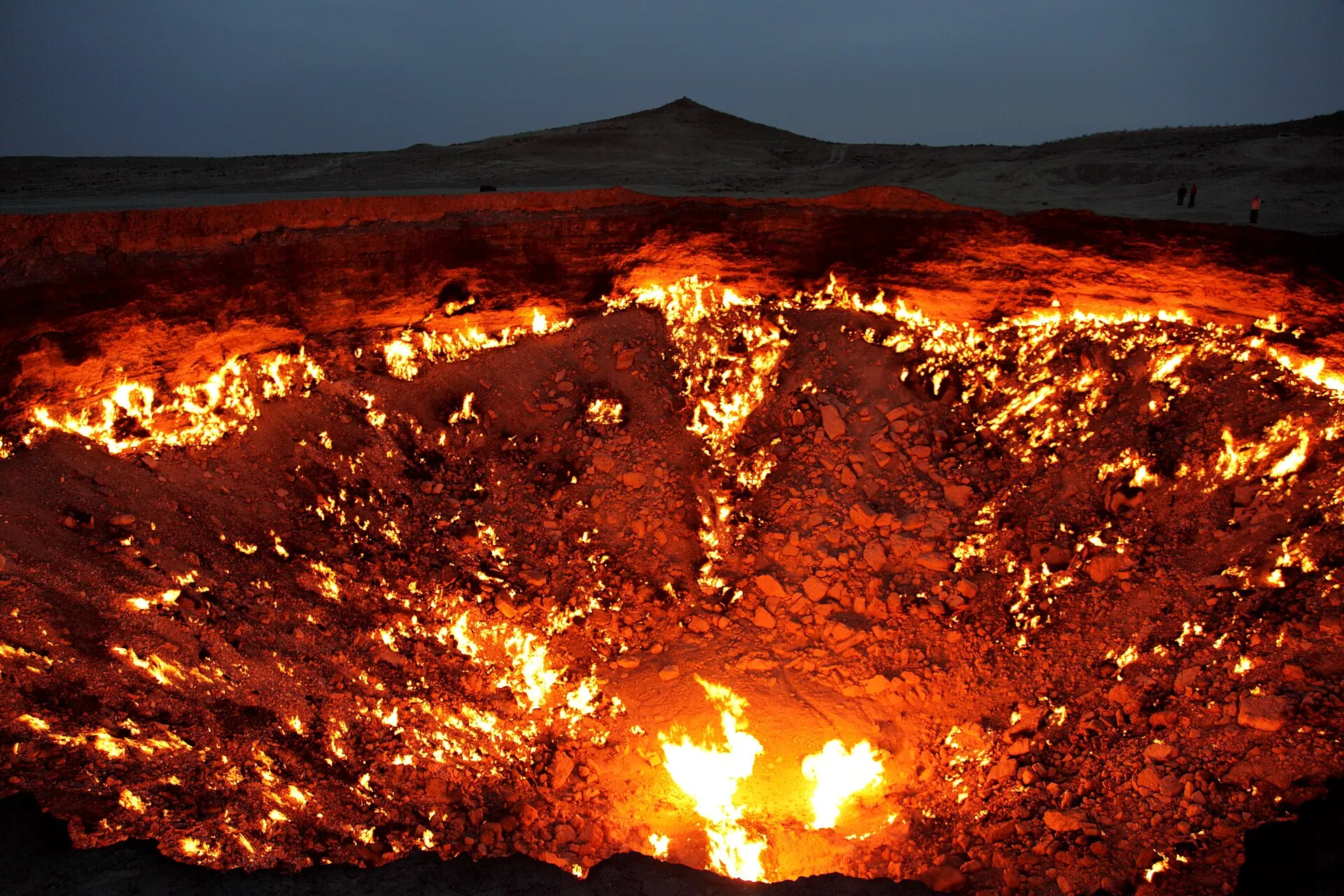
Location and access
The crater sits in the Karakum Desert roughly 160 miles north of Ashgabat, just off the highway near the small village of Darvaza, after which it is informally named. There is no fence, visitor center, or entrance fee. Travelers typically arrive on an organized desert tour, since the final stretch runs over unmarked sand tracks with no cell coverage for long distances.
Most visitors camp a short walk from the rim to watch the flames after dark, when the glow is most dramatic against the desert sky. The ground immediately at the crater's edge is loose and has crumbled before, so guides keep groups back from the lip. Daytime heat radiating off the pit is intense even from a distance, and the methane fumes carry a strong sulfurous smell depending on wind direction.
History and legend
The standard story credits Soviet engineers drilling for natural gas with accidentally collapsing the ground around 1971, after which geologists supposedly lit the escaping gas to burn it off safely, expecting it to exhaust itself within weeks. No Soviet-era document confirming this sequence has ever surfaced, and a 2025 satellite study complicates the timeline further: Landsat thermal data shows no active fire signature between 1984 and early 1988, meaning the crater likely vented gas unlit for well over a decade before anyone set it alight.
For most of its life the crater was simply a remote curiosity known mainly to desert travelers, until photographs of its nighttime glow spread online in the 2000s and turned it into a bucket-list destination nicknamed the "Door to Hell." The site's most concrete chapter of exploration came in 2013, when Canadian adventurer George Kourounis descended to the floor in a heat-resistant suit, becoming the first person on record to do so and recovering bacteria samples that survive at extreme temperatures.
Related places and beings
Darvaza belongs to a small worldwide family of places where fire or heat escaping from underground becomes its own tourist attraction. Eternal Flame Falls in New York runs on a gentler version of the same chemistry, a natural gas seep that burns behind a waterfall rather than inside a desert pit, while Ethiopia's Danakil Depression shows what happens when the heat comes from magma and hydrothermal brine instead of a gas pocket.
The crater's "first human descent" story also echoes the pattern seen at Mexico's Cave of the Crystals, where a hostile, nearly uninhabitable environment kept a natural wonder hidden until someone with the right protective gear finally went in to document it directly, turning local legend into measured, photographed fact.
In popular culture
Darvaza's glowing night shots have circulated widely on photography and travel blogs since the mid-2000s, frequently captioned with some version of "burning since 1971," a claim the 2025 satellite study shows is likely inaccurate for the fire itself even if the crater's collapse happened then. The National Geographic Channel series Die Trying built an entire 2014 episode around Kourounis's descent, cementing the "Door to Hell" nickname in English-language media.
Turkmenistan's government has leaned into the site's fame rather than hiding it, periodically floating plans to study, reduce, or eventually extinguish the fire while tour operators continue marketing overnight desert trips built around watching it burn after sunset. Reports since 2024 of visibly shrinking flames have added a new, genuinely unresolved chapter that photographers and researchers are both tracking.


