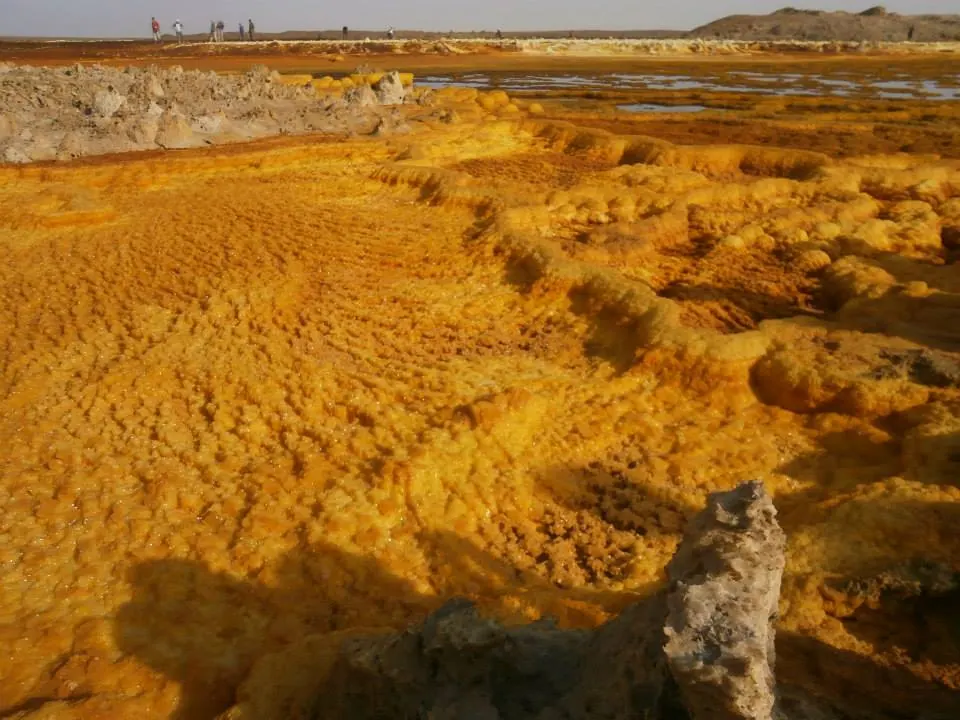
Colorful hydrothermal deposits at Dallol in the Danakil Depression
BARROWBOB / WIKIMEDIA COMMONS / CC BY-SA 4.0

Danakil Depression

Afar Triangle · Dallol
SCIENTIFICALLY EXPLAINED

Mainstream consensus: The Danakil Depression is a well-documented segment of the Afar triple junction, where the Nubian, Somali, and Arabian plates are pulling apart. Shallow basaltic magma beneath a thick evaporite layer drives the Dallol hydrothermal field's extreme acidity, heat, and vivid mineral coloring, among the best-studied "Mars analogue" sites on Earth.

Share this page
Short answer

The Danakil Depression is a scorching basin in Ethiopia's Afar region, where three tectonic plates pull apart, dropping the land over 100 meters below sea level. Shallow magma heats ancient salt into the acid-yellow Dallol field, one of Earth's most alien landscapes. It is real geology; access now requires armed escorts.

Location and access

The Danakil Depression spans a remote stretch of Ethiopia's Afar region near the Eritrean border, with its most visited feature, the Dallol hydrothermal field, reached by flying from Addis Ababa to Semera or Mekele and then joining a 4x4 convoy for a five-to-six-hour drive over lava track and salt flats to a base camp near Dodom.

There is no national park infrastructure, ticket office, or independent road access. Every organized trip requires an Afar regional permit, a guide from the local Afar community, and an armed police or military escort arranged through an established Ethiopian tour operator, a direct consequence of a fatal 2012 attack on tourists. As of 2026, both the U.S. State Department and UK Foreign Office advise against all travel to Afar due to ongoing regional conflict, and reputable operators suspend departures entirely while such advisories remain active. Travel, when it resumes, is recommended only from November through February, since daytime temperatures outside that window regularly exceed 45 degrees Celsius.

History and legend

Geologists identified the Danakil by the mid-20th century as a key piece of the Afar triple junction, the rare place on land where three tectonic plates, the Nubian, Somali, and Arabian, are actively pulling apart from one another. Seawater repeatedly flooded and evaporated in the closing northern Red Sea basin over the Pliocene and Pleistocene, leaving a salt layer roughly two kilometers thick across the plain, the same salt that later gave Dallol its strange chemistry.

Dallol's modern, acid-colored hydrothermal field is a comparatively recent and still-evolving feature. A phreatic steam explosion formed Black Mountain in 1926, and a 2004 magma intrusion beneath that same mountain opened a 4.5-kilometer fissure near Yellow Lake, triggering a fresh surge of hydrothermal venting that researchers have tracked closely ever since. Human history here took a darker turn in January 2012, when armed attackers killed five tourists camped on the rim of the nearby Erta Ale volcano, an event that still shapes every security rule governing Danakil travel today.

Related places and beings

The Danakil sits alongside a small set of places where extreme Earth chemistry does something that looks, at first glance, impossible without help from outside forces. Turkmenistan's Darvaza Gas Crater and Mexico's Cave of the Crystals both share that same pattern: a landscape so far outside ordinary human experience that it invites speculation, until fieldwork traces it back to measurable rock chemistry and heat.

Dallol's role as a leading Mars-analogue research site also connects it to a broader scientific conversation about habitability limits, the same conversation that makes places with genuinely sterile, hyperacidic pools scientifically exciting rather than simply dangerous tourist curiosities.

In popular culture

Photographs of Dallol's neon-yellow sulfur terraces and salt formations have become a staple of "most alien landscape on Earth" roundups across travel and science media since the 2010s, often paired with Erta Ale's lava lake in the same itinerary and the same photo essays. That visual fame sits uneasily alongside the region's genuine security risks, and responsible coverage increasingly pairs the striking imagery with current travel advisories rather than treating the Danakil as a simple bucket-list stop.

Scientific interest has grown in parallel, with NASA-adjacent astrobiology research using Dallol's extreme pools to study the outer limits of life on Earth as a proxy for what might, or might not, survive on Mars, giving the depression a second identity as a working planetary-science laboratory rather than only a photogenic curiosity.

Photos and illustrations

Mix of rights-cleared documentary stills and AI illustrations (labeled).

Dallol hydrothermal field colors in the Danakil DepressionCredit: Barrowbob / Wikimedia Commons / CC BY-SA 4.0
Sulphur pond amid Danakil mineral depositsCredit: Barrowbob / Wikimedia Commons / CC BY-SA 4.0
Danakil salt pan flatsCredit: Barrowbob / Wikimedia Commons / CC BY-SA 4.0
Illustrative scene for Danakil DepressionAI illustration for reference only

Visiting

loading map…

Independent travel is not possible or permitted. Visitors must join an organized convoy through an Ethiopian tour operator, which arranges the required Afar regional permit, a local Afar guide, and an armed police or military escort. As of late 2026, the U.S. State Department and UK Foreign Office advise against all travel to the Afar region due to armed conflict and past attacks on tourists; confirm current government travel advisories before booking any trip.

Legend vs history: The Danakil's extreme heat, low elevation, and acid-colored mineral terraces are documented geology confirmed by decades of fieldwork, not exaggeration. The genuinely contested history here is political and safety-related: a January 2012 attack killed five tourists near Erta Ale, and regional conflict has repeatedly opened and closed access since.

Reports and stories

Attributed reports, haunt claims, and discovery narratives from named sources. Links open the originals; AnomalyWiki does not verify these claims.

Claims vs mainstream

The claim

Dallol's colors and extreme chemistry are too alien to have a natural explanation on Earth.

Mainstream view

Researchers publishing in ACS Earth and Space Chemistry and PMC describe Dallol's yellow, orange, and green terraces as iron-, sulfur-, and salt-mineral precipitates driven by shallow magmatic heat beneath the Danakil's roughly 2-kilometer-thick evaporite sequence, a well-modeled hydrothermal process.

The claim

No life can survive in the Danakil's hottest, most acidic pools, proving it is a truly alien environment.

Mainstream view

Studies of Dallol's most extreme pools have found genuinely sterile conditions in some spots, but researchers frame this as valuable for Mars-analogue astrobiology precisely because it shows measurable limits of life on Earth, not evidence of anything otherworldly.

The claim

The region is simply too dangerous and remote for any organized, legitimate tourism.

Mainstream view

Established Ethiopian tour operators have run regular convoy departures to Dallol and Erta Ale for years when security conditions allow, using armed escorts and Afar community guides, though access depends heavily on the current regional security situation.

The claim

Dallol's dome and hydrothermal field formed recently from active volcanic eruptions.

Mainstream view

Research in ACS Earth and Space Chemistry found no volcanic lava, ash, or scoria at the surface around Dallol; the dome instead formed through shallow magma intrusion deforming and heating the overlying salt layer, a process distinct from a typical eruptive volcano.

Timeline

  1. Pliocene-PleistoceneSeawater repeatedly floods and evaporates in the closing northern Red Sea basin, depositing a salt sequence roughly 2 kilometers thick across the Danakil plain.Source: Frontiers in Earth Science, "Origin and Evolution of the Halo-Volcanic Complex of Dallol" (2019)
  2. 1926A phreatic (steam) explosion forms Black Mountain at the southwestern edge of Dallol, an early sign of shallow magmatic-hydrothermal activity beneath the salt dome.Source: PMC, "A Polyextreme Hydrothermal System Controlled by Iron"
  3. January 2012Armed attackers kill five tourists on the rim of the Erta Ale volcano crater, prompting years of tightened security requirements, including mandatory armed escorts for all Danakil tours.Source: Volcano-Guide.com, Erta Ale travel advisory summary
  4. 2004A dyke intrusion beneath Black Mountain opens the 4.5-kilometer Yellow Lake fissure near Dallol, reactivating hydrothermal venting that researchers continue to monitor.Source: Frontiers in Earth Science, "Tectonic and hydrothermal activity at the Yellow Lake fissure" (2023)
  5. 2026The U.S. State Department maintains a "Do Not Travel" advisory for the entire Afar region amid ongoing conflict, and tour operators suspend most Danakil departures while it remains in effect.Source: ethiopiaunlocked.com, Danakil Depression travel advisory summary (2026)

FAQ

Why is the Danakil Depression so hot and colorful?

Shallow basaltic magma heats a roughly 2-kilometer-thick layer of ancient sea salt, producing hyperacidic, mineral-rich brines that precipitate the yellow, orange, and green terraces seen at the Dallol hydrothermal field.

Is it safe to visit the Danakil Depression?

Access depends entirely on current security conditions. As of 2026, the U.S. and UK both advise against travel to the Afar region, and visits that do run require an Afar regional permit, local guide, and armed escort arranged through an established operator.

What caused the 2012 attack near Erta Ale?

Armed assailants attacked a tourist camp on the volcano's crater rim in January 2012, killing five visitors. The attack permanently changed Danakil tourism by making armed escorts a mandatory condition for all organized trips.

Can anything live in Dallol's hot springs?

Some of its hottest, most acidic pools appear genuinely sterile, which researchers find scientifically valuable precisely because it marks a measurable edge of habitability on Earth, used to study possible life limits on Mars.

How low is the Danakil Depression below sea level?

Parts of the basin, including Lake Assale, sit as much as 124 meters below sea level, making the Danakil one of the lowest and hottest inhabited-adjacent land areas on the planet.