Location and access
Waitomo sits in the Waikato region of New Zealand's North Island, about two hours south of Auckland or an hour from Hamilton. The modern visitor centre runs timed boat tours through the Glowworm Grotto and separate walking tours through the dry upper chambers, known as the Catacombs, the Pipe Organ, and the Banquet Chamber.
Photography is restricted inside the Grotto itself, since artificial light stresses the larvae and dims their glow over time. The site is a working tourist operation with set tour times rather than a free-roam cave, so booking ahead during peak season is worthwhile.
History and legend
Local Maori knew of the cave's stream entrance well before 1887, but oral tradition held the darkness beyond it as the home of taniwha and other fabulous creatures, a caution recorded directly in an 1889 government survey report. That belief, rather than any physical barrier, is credited with keeping earlier generations from pushing further in.
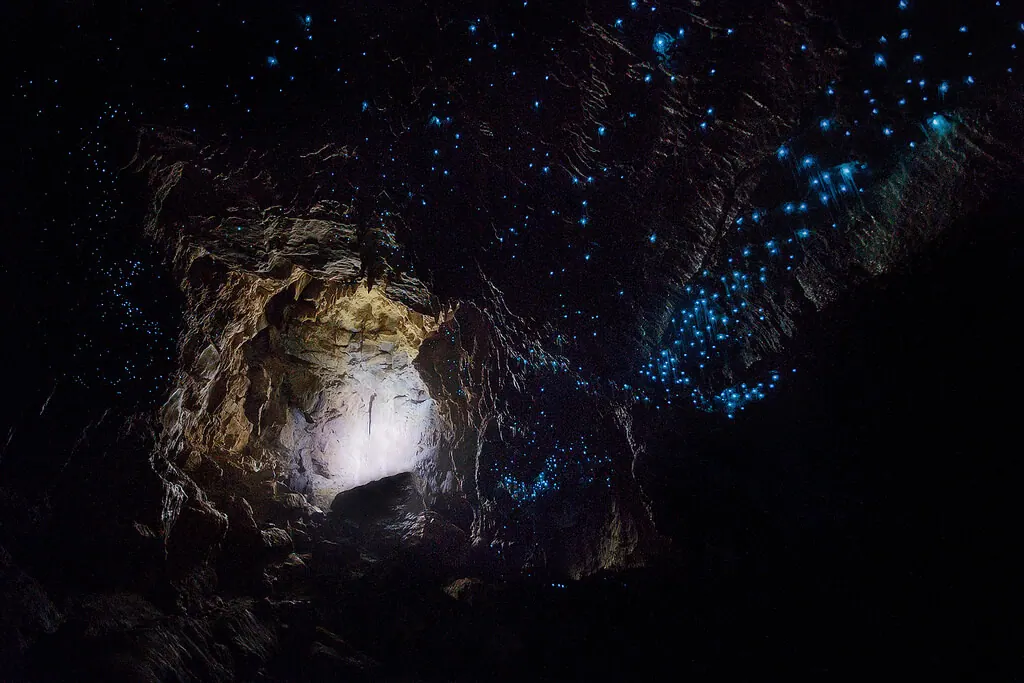
On 28 December 1887, Tane Tinorau, a Maori chief of the local hapu, and Fred Mace, an English surveyor, floated a flax-stem raft into the stream passage by candlelight. What they found when their eyes adjusted to the dark was the Glowworm Grotto: a ceiling studded with thousands of tiny blue-green lights. Within two years Tinorau was guiding paying visitors through the cave, and in 1906 the government took over formal administration. The land and cave returned to Tinorau and his wife Huti's descendants in 1989, and family members still guide tours today.
The light comes from Arachnocampa luminosa, a fungus gnat found only in New Zealand. Each larva hangs sticky silk lines from the cave ceiling and glows blue-green through a luciferin-luciferase chemical reaction, luring flying insects into the trap, a mechanism studied extensively enough that no scientific mystery remains beyond fine details of the chemistry's efficiency. The cave's limestone itself is roughly 30 million years old, carrying two levels of passage totaling about 1,300 meters: a dry upper route through the Catacombs, the Pipe Organ, and the Banquet Chamber, and a stream-level lower route where the Grotto sits. The pre-1887 taniwha caution remains interesting cultural history, but no evidence points to any hazard inside the cave beyond ordinary caving risks such as drowning or falls.
Related places and beings
Waitomo belongs on the same shelf as other sites where biology or chemistry produces a spectacle people initially read as mysterious: the Cave of the Crystals, the Darvaza gas crater, Fly Geyser, and Pamukkale's travertine terraces. Cross-category, Foo Fighters offer a useful contrast: unexplained aerial lights with no settled mechanism, next to Waitomo's fully explained biological light show.
In popular culture
Waitomo appears regularly in New Zealand tourism campaigns, nature documentaries, and photography features on bioluminescence, usually alongside other Arachnocampa sites in New Zealand and Australia's related glowworm populations, and the Discover Waitomo visitor centre now frames the Tinorau family's century-long guiding tradition as central to the site's story, not just a historical footnote.


